What everyone gets wrong about category creation
(And how to avoid making the same mistake with your AI startup!)
What does it actually take to create a new category?
For a company like Gong, it seems as simple as changing the name on their homepage (something they do every single year):
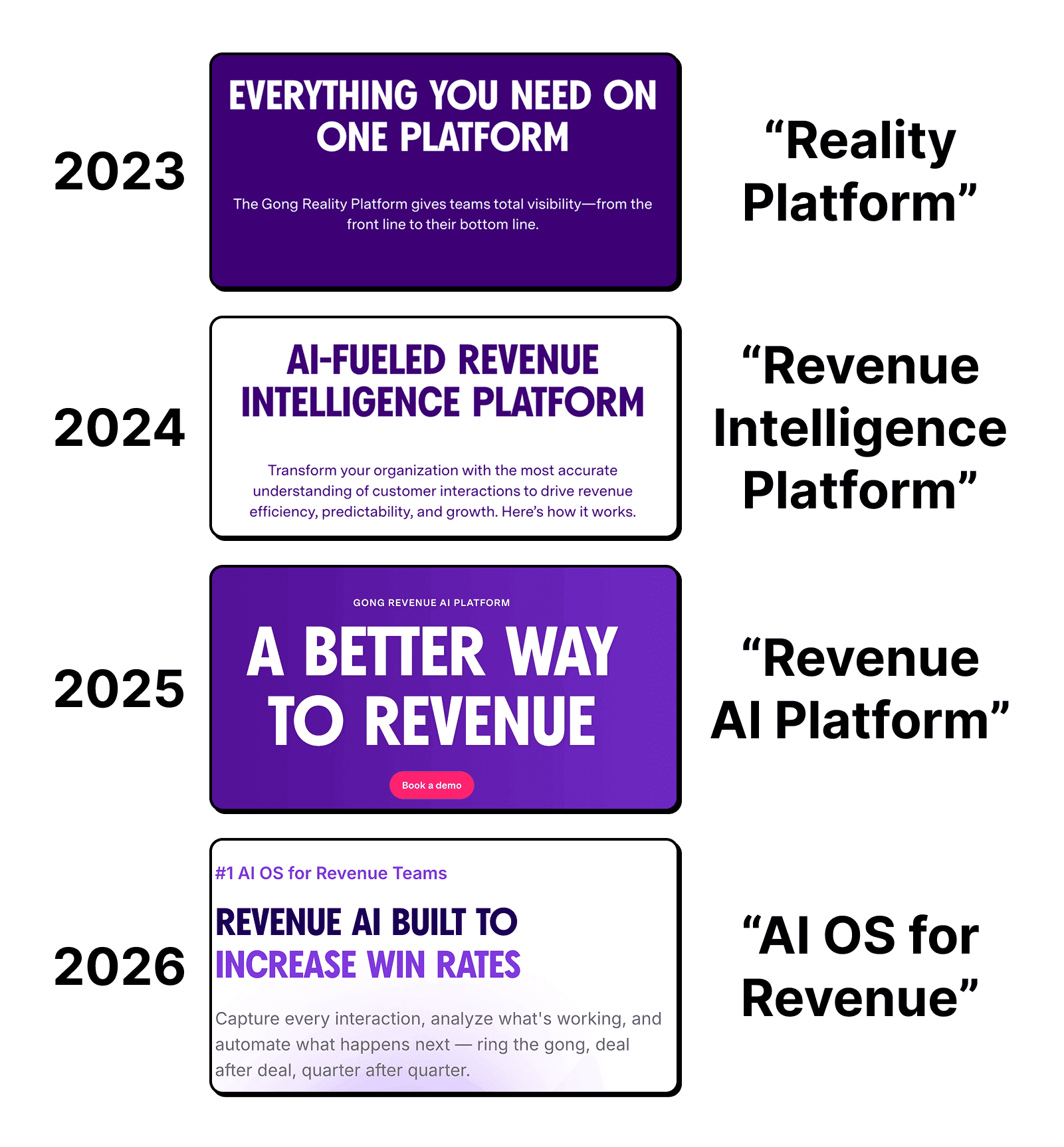
Most of us will see this and roll our eyes.
Real marketing practitioners know these are usually the result of executives engaging in top-down, hype-chasing slop without meaningfully altering their product.
I don't have eyes or ears inside Gong's GTM org, but I can imagine they aren't thrilled with the whiplash of new category names.
When a prospect tells a Gong account executive, "We are really looking to get your call-recording software," do you think any of them will say, "Oh sorry, it's actually not call-recording… it's actually a 'Reality Platform'"?
All jokes aside, there's obviously something powerful about actually creating a new category.
There are countless books written about it and countless consultants eager to teach it to you.
But among the hundreds of companies we've worked with over the last four years, most have a very broken understanding of how it's actually done.
And most end up falling prey to the same mistakes Gong has made over and over.
(One caveat: maybe you're thinking, "but Gong is a very successful company!" They absolutely are… but I would argue it's in spite of their category-naming nonsense. Ask anyone in B2B to name the top five "Reality Platforms," and you'll see that nobody knows what this means. No other companies have adopted that language. Additionally, the fact that Gong renames their category every year is proof that their efforts are not working. Salesforce has used "CRM" as their stock ticker since going public in 2004. Okay, rant over.)
(One more caveat: this model is primarily for B2B software companies. If you're a B2C company or a business that makes physical products, you may find some helpful principles in here… but you'll also find edges where this breaks.)
Let's dive in.
I want to start with what should be an obvious principle:
Companies consist of employees doing lots of different tasks.
Every job description (from the CEO to the intern) includes a list of workflows or initiatives each person needs to own.
Each responsibility can be referred to as a Job-to-be-Done (JTBD).
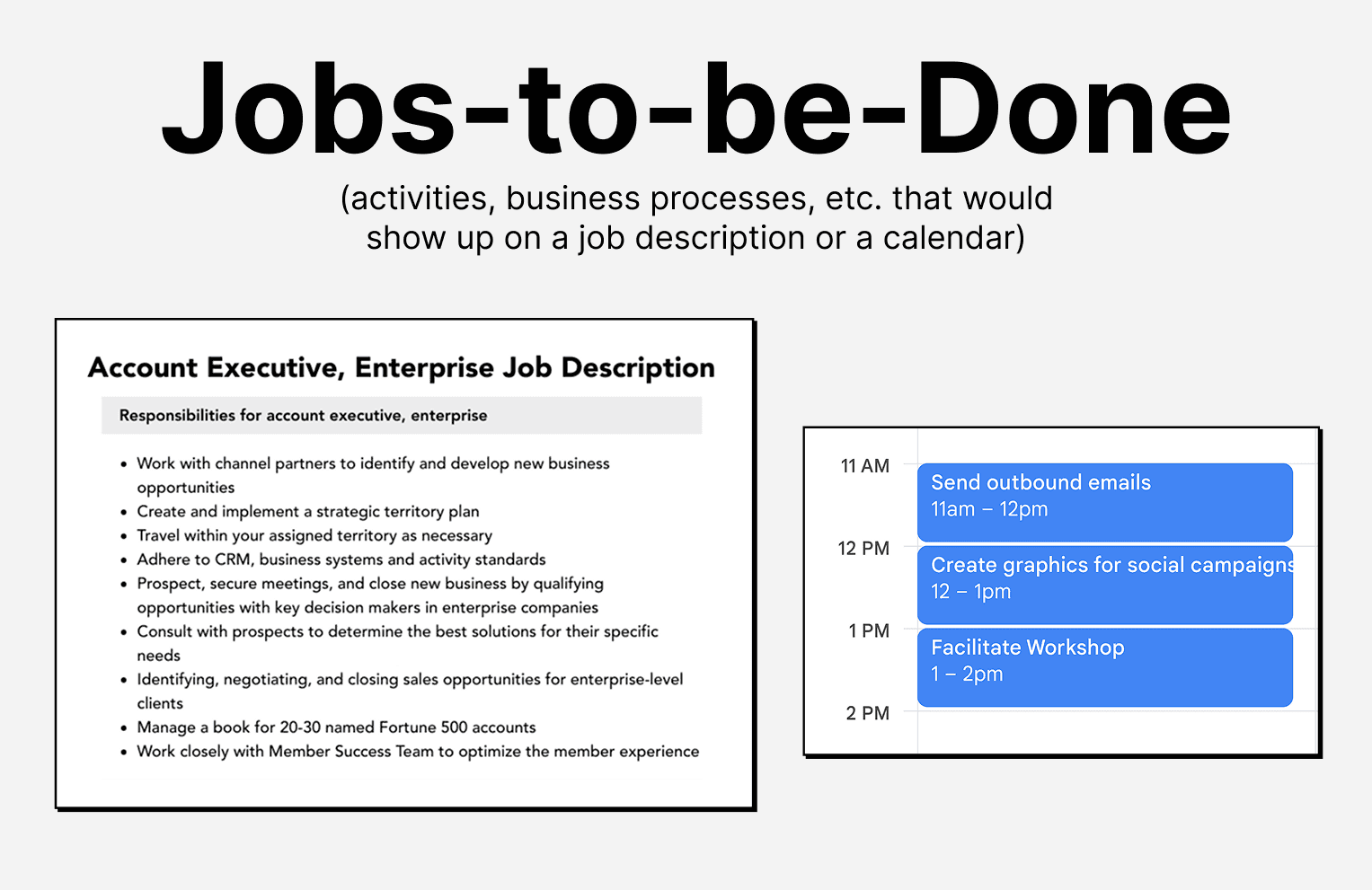
There are a variety of ways employees can accomplish these jobs-to-be-done. They might tackle them manually. Maybe they'll create an internal tool with the help of IT.
Or they'll go looking for software that's built for that specific task.
B2B software companies build categories AROUND these jobs-to-be-done.
This means that every B2B category has a corresponding job-to-be-done.
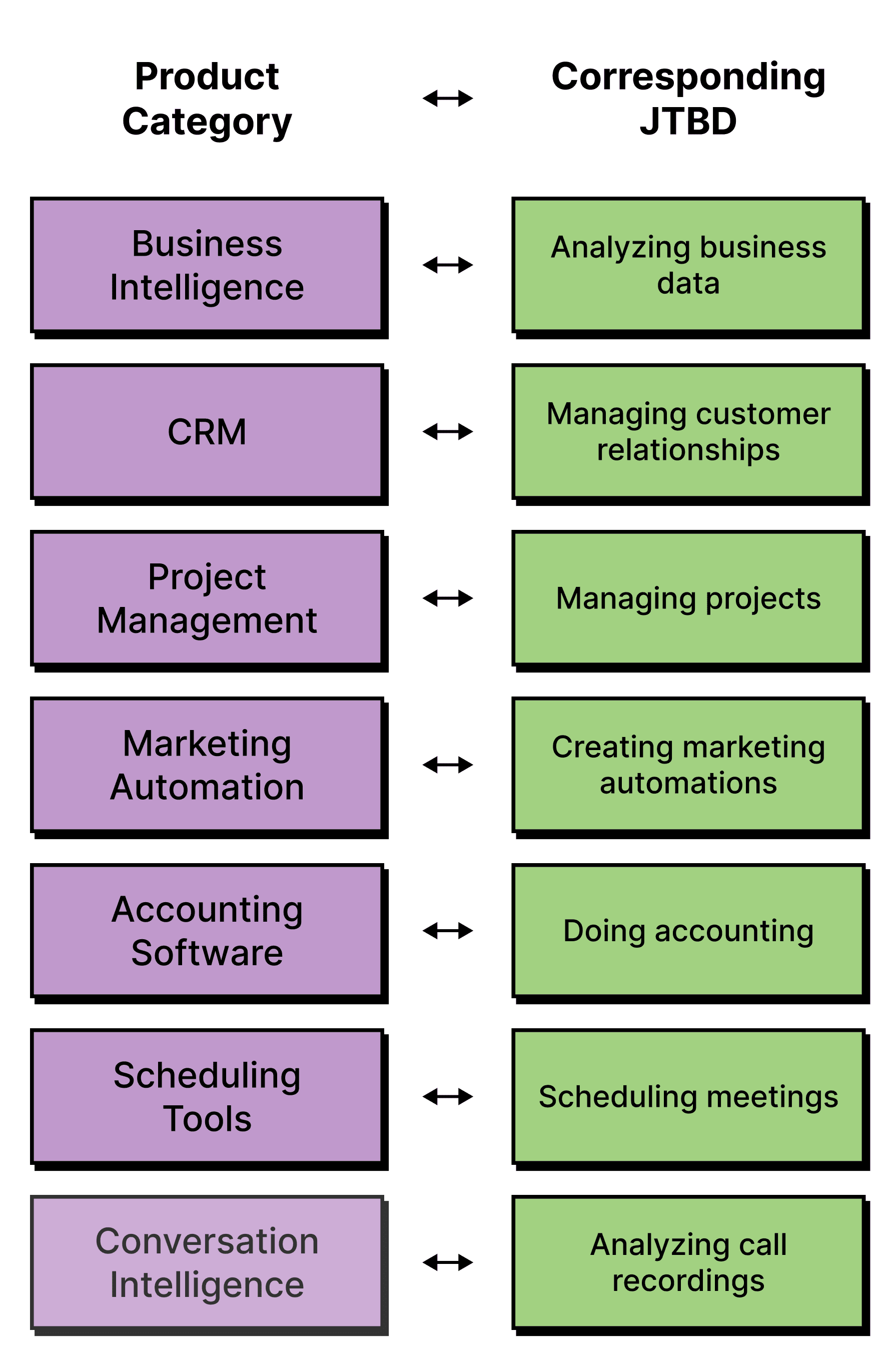
So, if you're going to create a new category, you need a corresponding JTBD.
Unfortunately, hardly anyone thinks about this when going through a category creation exercise.
Most of the time, companies take multiple disparate product categories (with many distinct JTBDs) and smash them together into a "platform."
Usually, what's considered "category creation" is actually just a labeling exercise.
Time is spent in the boardroom figuring out what to call the category (as if the name will determine its success).
In reality, the only thing that matters is this: does the underlying JTBD currently exist? And have you created a new type of tool that can handle it end to end?
If the answer is yes, then choosing the name is simple. Just invert the phrasing of the JTBD (like "managing customer relationships" to "Customer Relationship Management").
More often than not, there simply is no underlying JTBD for the new "category."
And if there's no JTBD, then it's not likely that anyone will buy the entire platform all at once.
Why would they?
We look at our to-do list, then evaluate whether or not each item will need a software tool.
Why would anyone buy a tool for a task that doesn't exist?
Case Study: Clari
Let's use the company Clari as another real-life example.
They have six core products:
- Pipeline Management
- Sales Engagement
- Mutual Action Plans
- Conversation Intelligence
- Forecasting Tool
- AI Agents
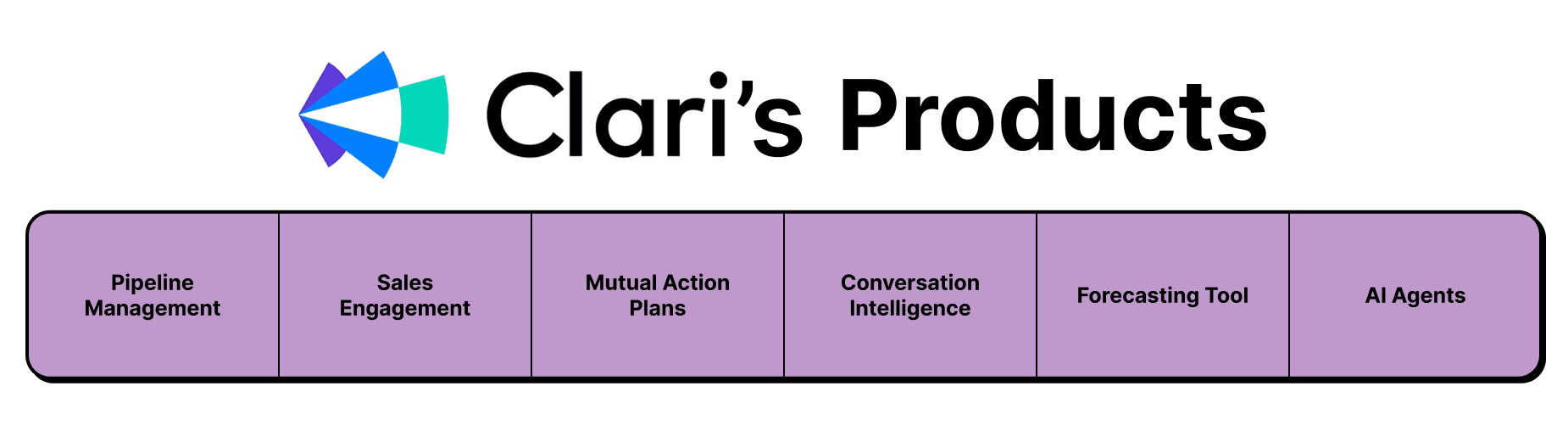
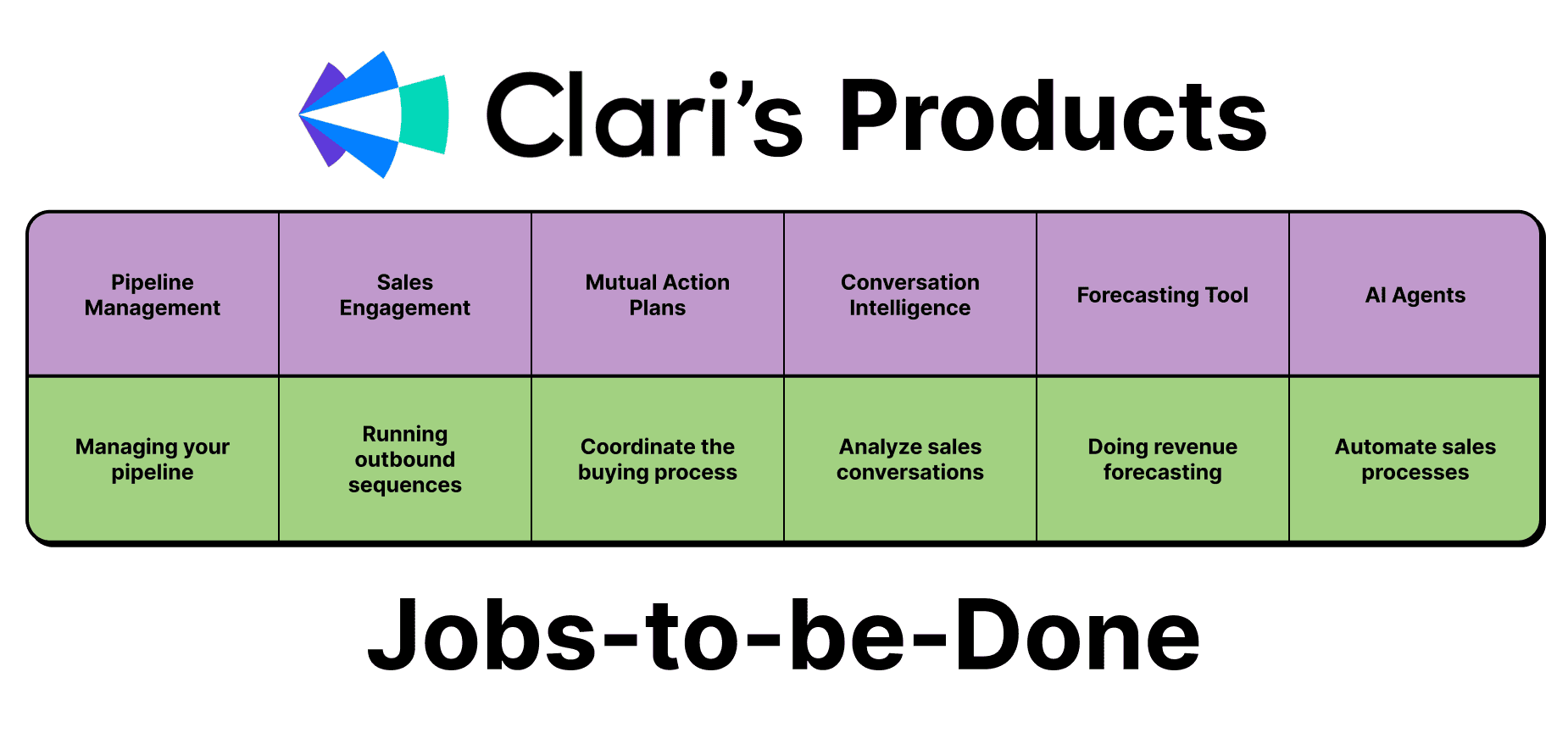
These are all very real and mature categories. Other vendors claim each category name.
This makes sense, because each category has a corresponding (real) JTBD:
Obviously, if I am Clari, I want to sell the whole platform all at once.
The bigger the footprint, the higher the ACV.
And so, Clari went through an internal exercise to land on a name for this new category.
Ultimately, they chose to call it an "Enterprise Revenue Orchestration" platform.
If we convert this category to a JTBD, we end up with something like "orchestrate enterprise revenue."
This likely would encompass all the sub-jobs-to-be-done of the different products that make up Clari's platform.
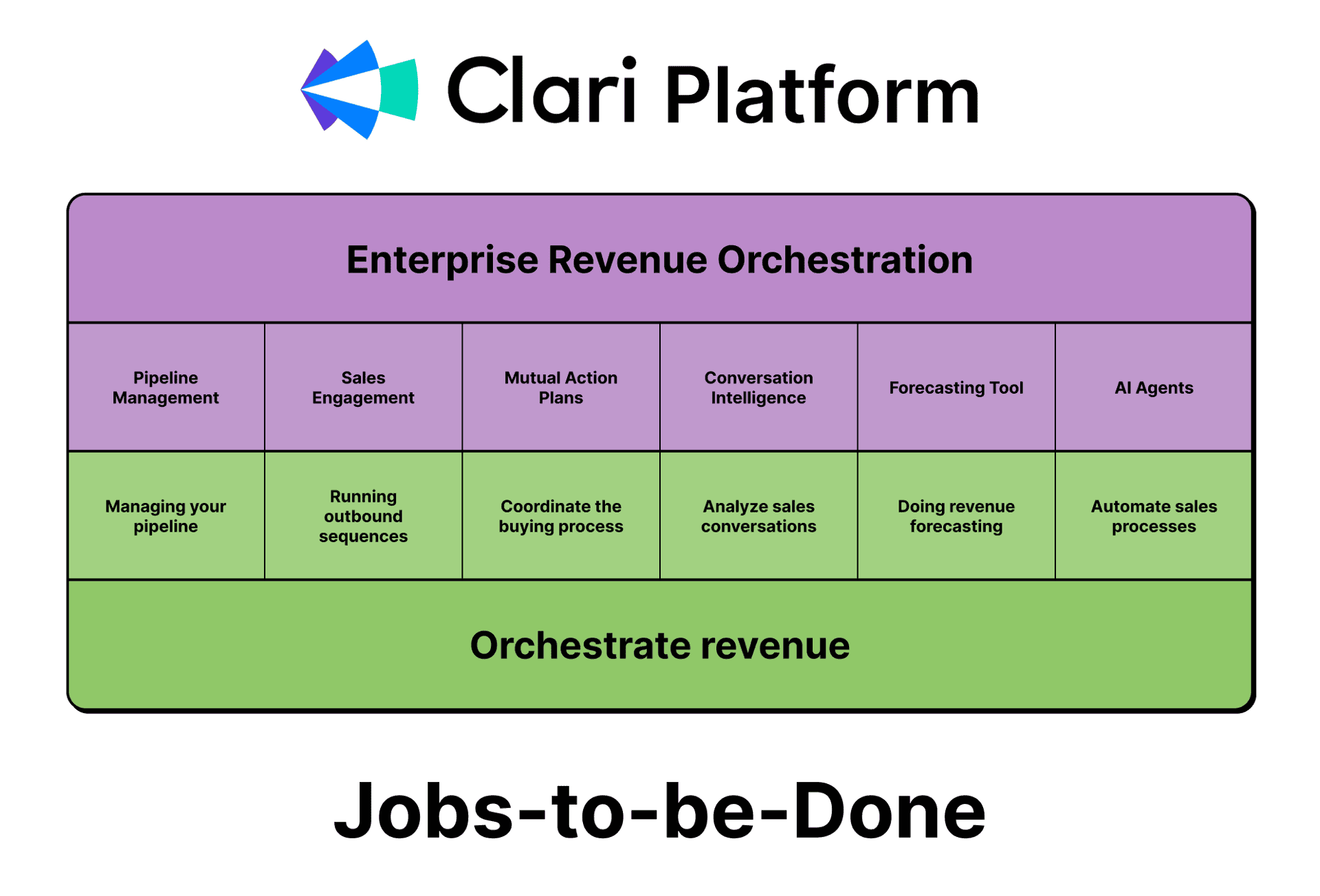
But there are a few problems…
Do any enterprise sales leaders view their job as "orchestrating revenue"? In other words, is this a real JTBD that would appear in someone's list of responsibilities?
Perhaps the answer is yes. If we grant them this, there is still another issue:
This is such a high-level JTBD that it includes hundreds of other things that Clari's platform doesn't touch.
Things like…
- Aligning marketing, sales, solutions, legal, finance, and customer success around target accounts
- Defining the enterprise go-to-market strategy
- Setting revenue goals, quotas, territories, and account ownership
- Removing procurement, security, legal, and implementation blockers
- Setting pricing, packaging, discounting, and approval rules
- Assigning executive sponsors to strategic opportunities
- Managing channel and technology partnerships
- Ensuring clean handoffs from sales to implementation and customer success
- Driving renewals, expansion, and multi-product adoption
- Monitoring revenue performance across acquisition, retention, and expansion
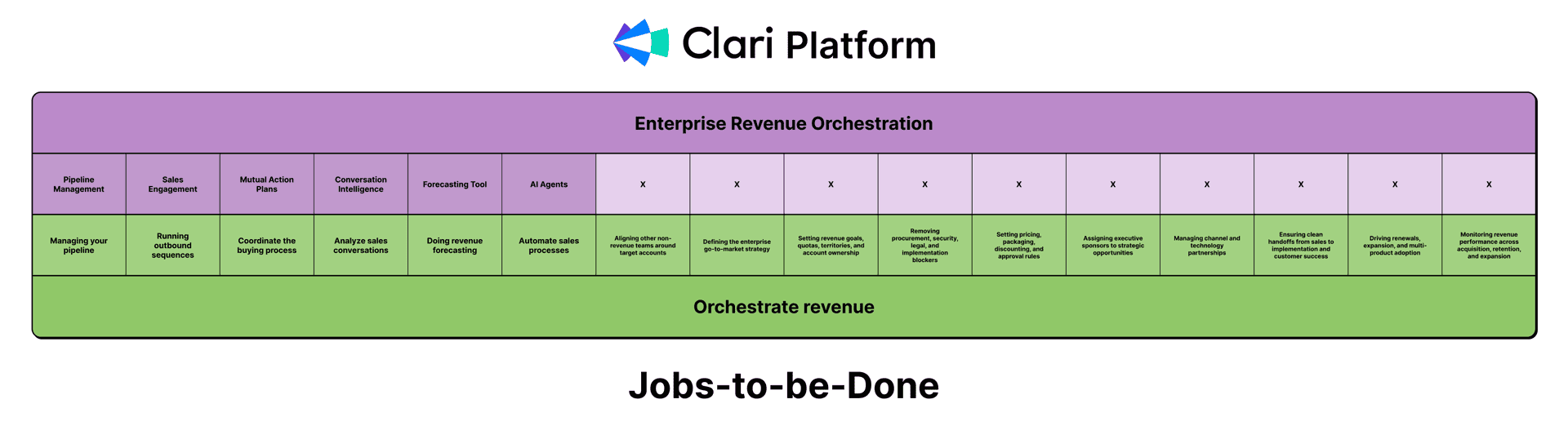
This gap between what the category promises and the underlying jobs-to-be-done creates extreme ambiguity and risks positioning the platform to drastically under-deliver against its implied promise.
Imagine a sales executive who has heard of Clari, but doesn't quite know what they do.
Clari's account executive says, "We help you orchestrate revenue."
This would likely be met with confusion… and would be followed with a question like, "Can you be more specific?"
In reality, there likely is no JTBD that spans that specific grouping of sub-JTBDs.
The exercise of coining this name is mostly marketing theater: lots of hoopla that results in no additional clarity.
I'm not a betting man, but I would wager that this category won't actually form (i.e. no other companies will claim this category for themselves).
If Clari wants to sharpen their positioning, they have three options:
Option 1 - Create the missing Job-to-be-Done
Before creating the category, they would spend time first creating the JTBD.
They could use their vast resources to attempt to convince the world that "revenue orchestration" is in fact a very real task/workflow/initiative, and that it spans those six specific underlying JTBDs that their category supports.
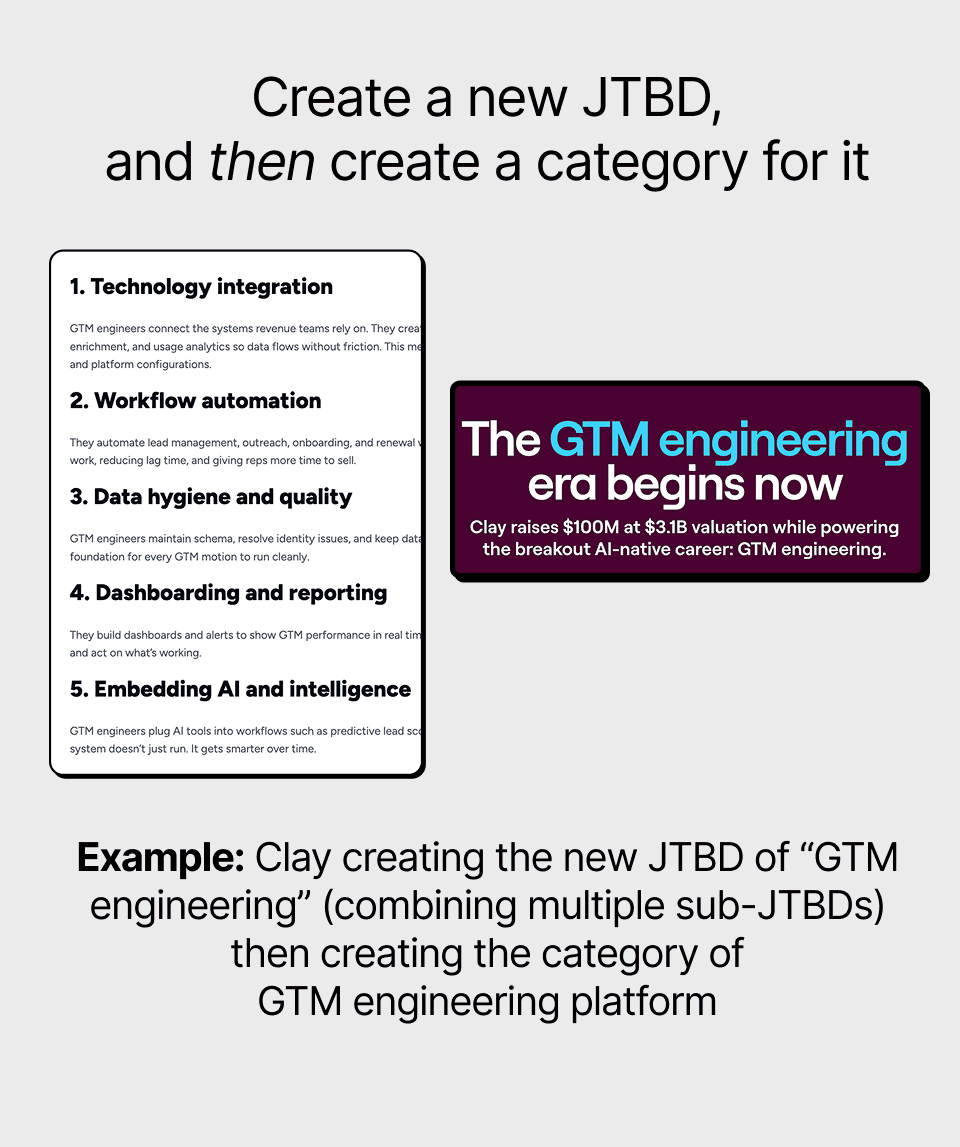
Clay would be a successful example of this approach.
They took a collection of unrelated tasks (i.e. integrating technology, automating workflows, doing data hygiene, creating dashboards and reporting, embedding AI into processes, running outbound sales, etc.) and combined them into one new JTBD:
"GTM engineering."
Those tasks were previously done by different teams at different moments in time.
No single person owned all those responsibilities, and there was no existing JTBD that covered it from start to finish.
Clay first had to create the JOB before they could pitch the new CATEGORY.
(Ironically, they actually created the literal role of GTM Engineer that companies began to hire.)
Option 2 - Dissolve the platform into a suite of products
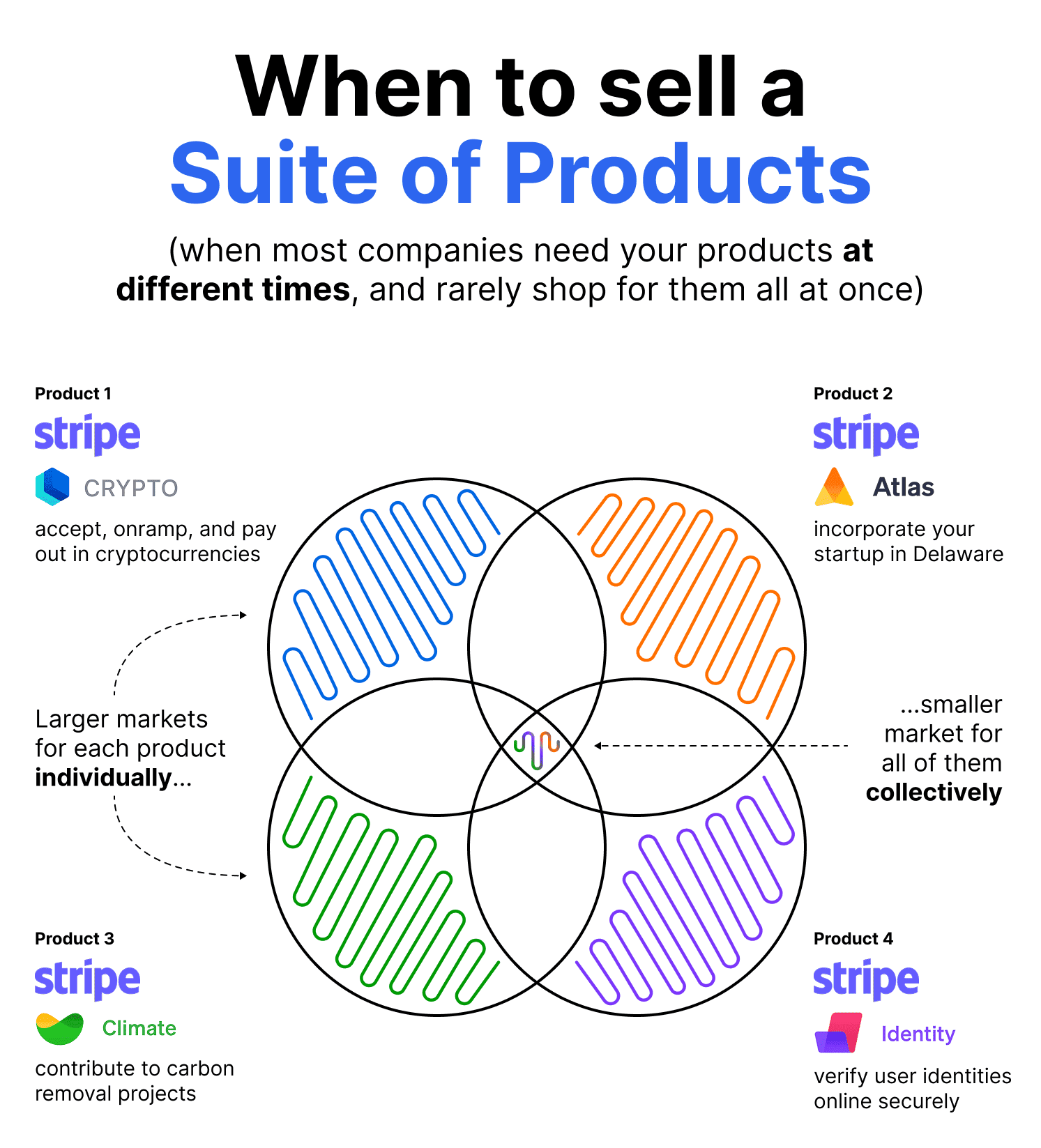
Clari also has the option to dissolve the platform altogether and sell a suite of products instead.
This is what Stripe does. There is no unified "platform story" that includes both Stripe's payments product and the one that helps you incorporate your startup in Delaware (Stripe Atlas).
Option 3 - Go back to leading with their most well-known product
Despite Clari's best efforts, most people still think of them as a forecasting platform. I do not have data on this, but I would bet most of their sales calls start with prospects who are coming primarily for their forecasting product.
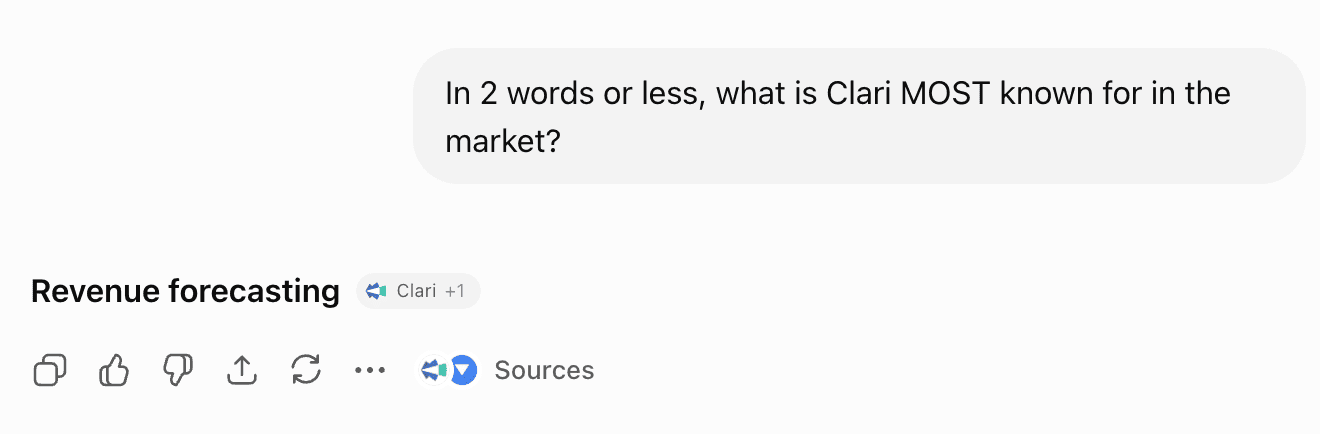
They can continue to fight this… or they can lean into it!
Use forecasting as a "trojan horse" to get their foot in the door, and then after providing value, they can upsell the other products in the suite.
It's a lot easier for companies to buy a Forecasting Platform than a "Revenue Orchestration Platform."
If you're a one-hit-wonder, you can either constantly complain about it… or you can continue selling out shows.
We would love your feedback on this newsletter! Please shoot over your thoughts to fletcher@fletchpmm.com.
Additionally, if you have someone who you think would be interested in product positioning, consider inviting them to subscribe (just send them this link).
FletchPMM is a positioning consultancy that has helped 500+ B2B software companies find their positioning strategy, document it in an internal deck, and share it on a rewritten homepage.