Should you incorporate AI in your positioning?
(Send this to your boss and ask which strategy they are using!)
As someone who works in positioning, I look at a lot of homepages. I am particularly interested in how tech companies talk about themselves.
And I started seeing a pattern.
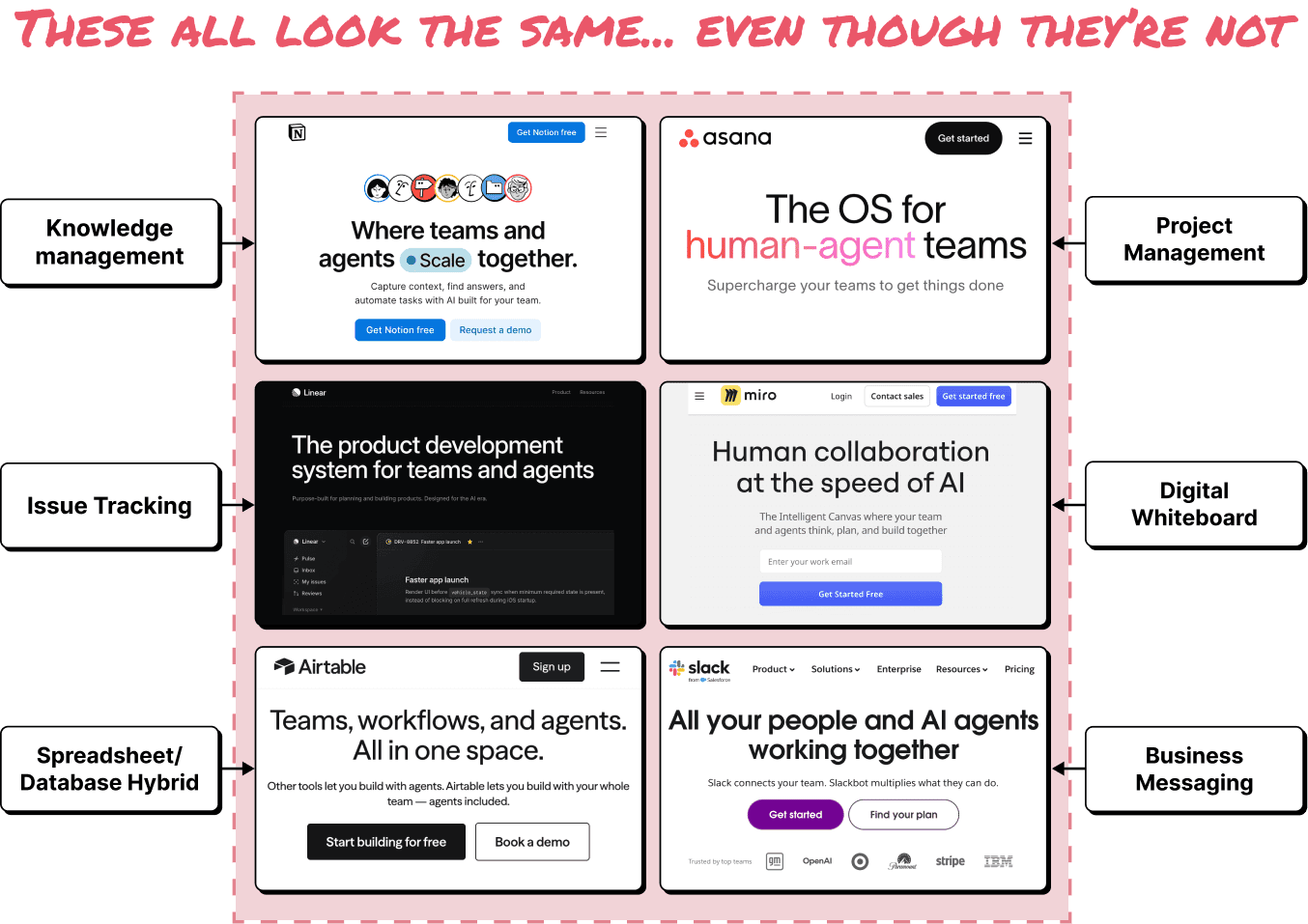
These are very different products, for very different audiences, with different use cases and different competitors.
Notion is commonly used for knowledge management.
Asana is used for project management.
Slack is a business messaging app.
Linear is for issue tracking.
Airtable is a spreadsheet-database hybrid.
But if you visit their websites, all these products look like they’re selling the same thing: a workspace for humans and agents.
What’s going on?
There are three possible explanations:
Maybe everyone is looking for a human-agent workspace. Slack, Miro, Airtable, and everybody else could have arrived at the same conclusion independently.
In this theory, every company’s research converged at the same time, and everyone changed their landing pages overnight.
That seems a little far-fetched.
The second reason seems more likely:
I think it's more likely that they looked around and panicked. “Oh my gosh, Slack is leading with agents. We need to lead with agents, too!”
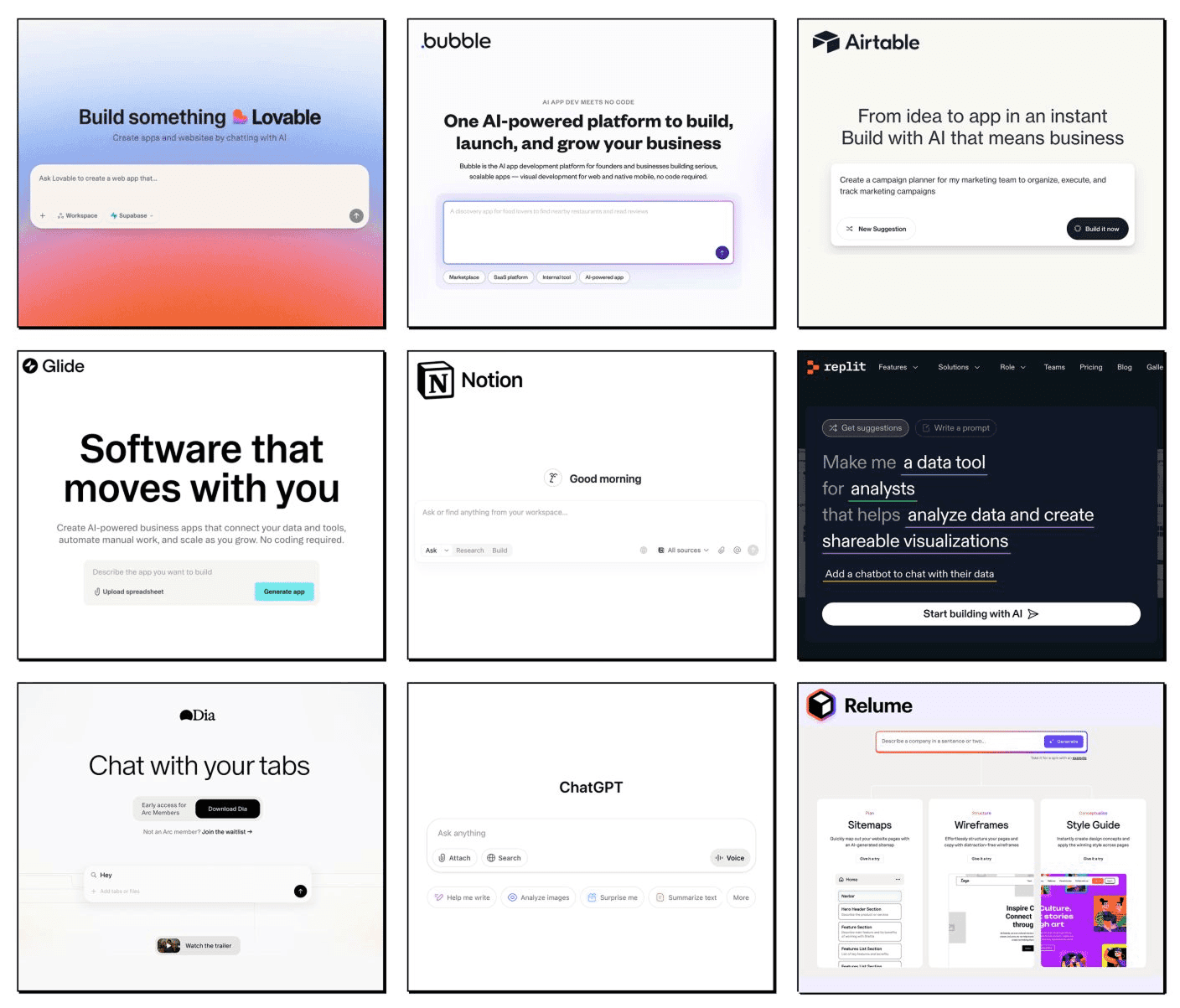
We saw something similar when ChatGPT, Claude, and Lovable started taking off. Website heroes that once explained each company’s unique positioning suddenly morphed into giant chat boxes.
This is a big part of why Fletch exists. Our goal is to help people think carefully about how they position their companies, rather than blindly following trends.
We help them understand the implications of pivoting, changing, and putting themselves in one group over another.
All these decisions have huge consequences. They change how people think about you, whether they understand your value… or whether they get confused.
So how should (or shouldn’t) AI get incorporated into your positioning?
Should it be presented as the core thing you do? A secondary message? A supporting argument?
Could we avoid talking about it altogether?
That last option might sound impossible at the tail end of 2026. But it is an option.
There are three main strategies I'm seeing.
As I go through them, think about what you’re currently doing. Which strategy are you using? And is it actually the one you should be using?
Let's go through each one, why you might choose it, and how it can go wrong.
P.S. If you find this newsletter helpful, please share it with other members on your team. Hopefully, we can raise the collective understanding of the dark art of positioning 🙂
Strategy 1: Pivot into a new AI category
The first strategy is to leave your old SaaS category and move into a new AI category.
Let’s look at Mutiny.
For a long time, Mutiny positioned itself as website personalization software. It allowed a company’s homepage to change based on the visitor, which was a powerful way to create mini-ABM campaigns.
Then came the AI revolution, and Mutiny pivoted.
Their new positioning became: “A GTM assistant built for customer-facing work.” It doesn't explicitly say AI, but everyone reads “assistant” as an AI assistant.
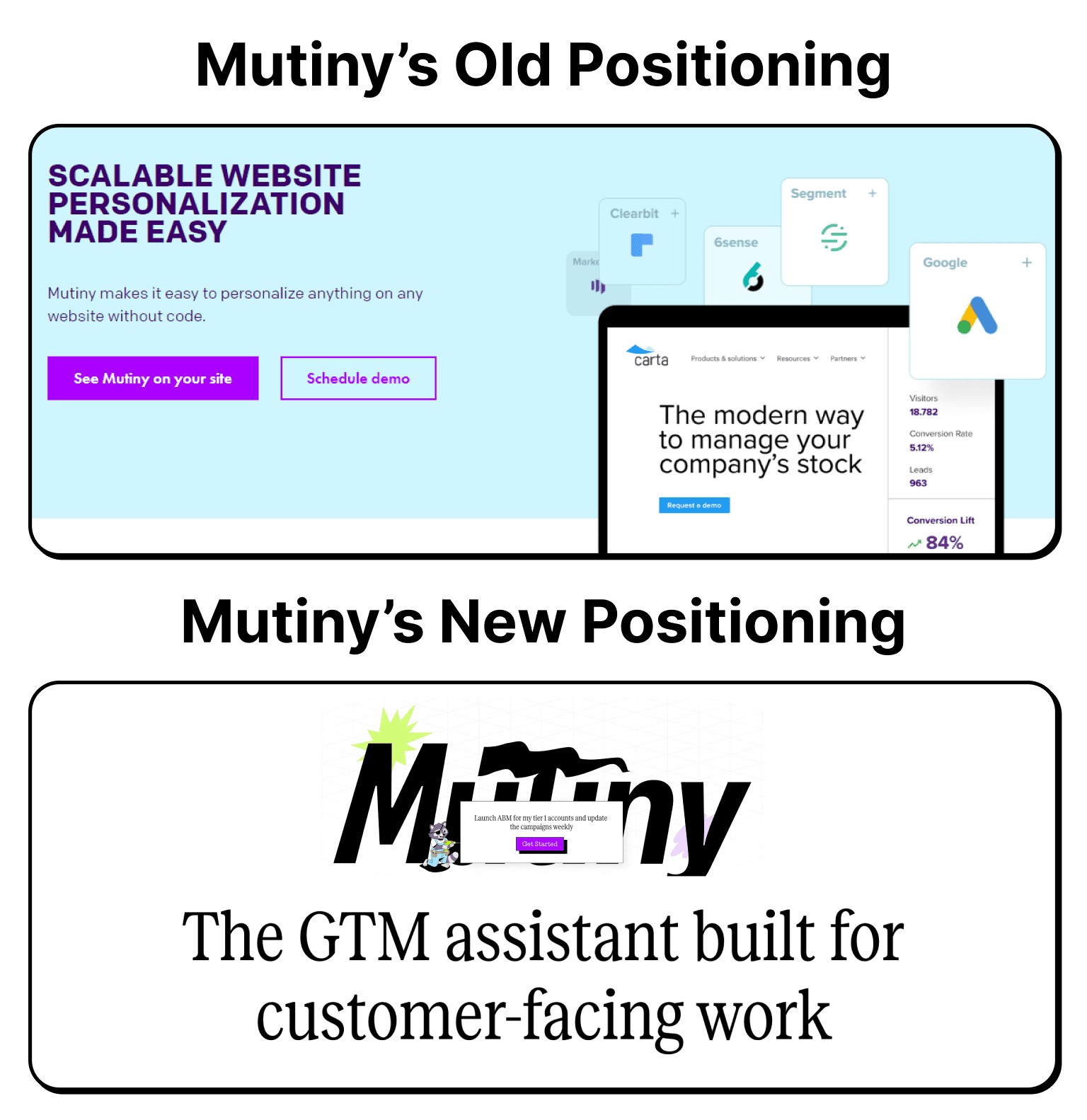
They moved from one shelf at the grocery store to another shelf in a completely different aisle.
The founder talked publicly about why they made the change. They were looking at where growth was happening and betting on where future growth would come from.
They went all in, even walking away from an eight-figure business to pursue this new strategy.
Passionfroot is another example.
It started as a tool to help creators land brand deals.
Its new positioning became: “The Agentic Marketing OS for the AI era.”
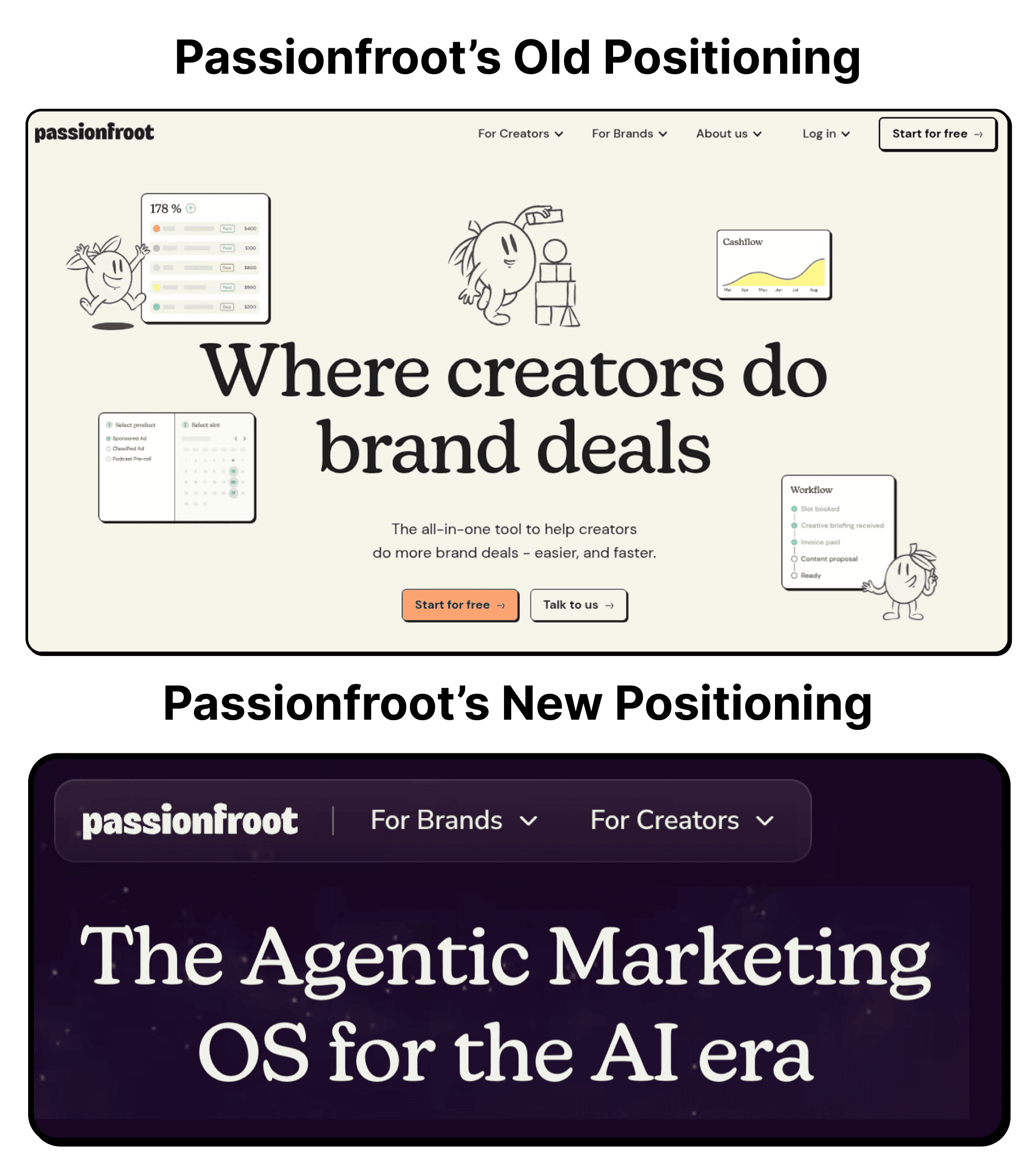
Their founder had a similar message around the launch: we think the opportunity is in AI, so we're going all in.
They don't want you to think of them in the old category. Instead, you should associate us with this new AI category.
Reasons to choose this strategy
1) You believe SaaS is going to die
Manny Medina, cofounder of Paid, literally flew a banner reading “SaaS is dead” over the SaaStr conference.

He (like many others) believe AI will undermine per-seat pricing as agents perform work and reduce the number of paying humans.
He believes this is the way of the future, and positions his company accordingly. If you have the same level of conviction, that can be a reason to stay ahead of the curve and position your company within a new AI-centric category.
2) You're going after an extremely AI-forward audience
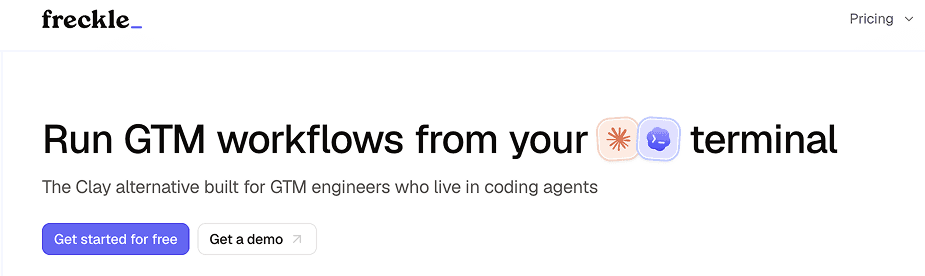
Nathan Merzvinskis is the founder of Freckle.
He sells to one of the most AI-forward customer segments: GTM engineers. They're already running everything out of the terminal.
They're annoyed when they have to go back into Clay’s SaaS platform.
For the AI-forward audience, this old way of interacting with software may no longer fit how they want to work.
Freckle tells them they can run their GTM workflows right out of the terminal.
For this group, moving out of the SaaS-centric enrichment category made sense.
3) Your AI product is significantly outperforming your SaaS product
A lot of companies launched AI agents as soon as possible. For some of these companies, those agents became the thing they were known for and the thing that helped them succeed.
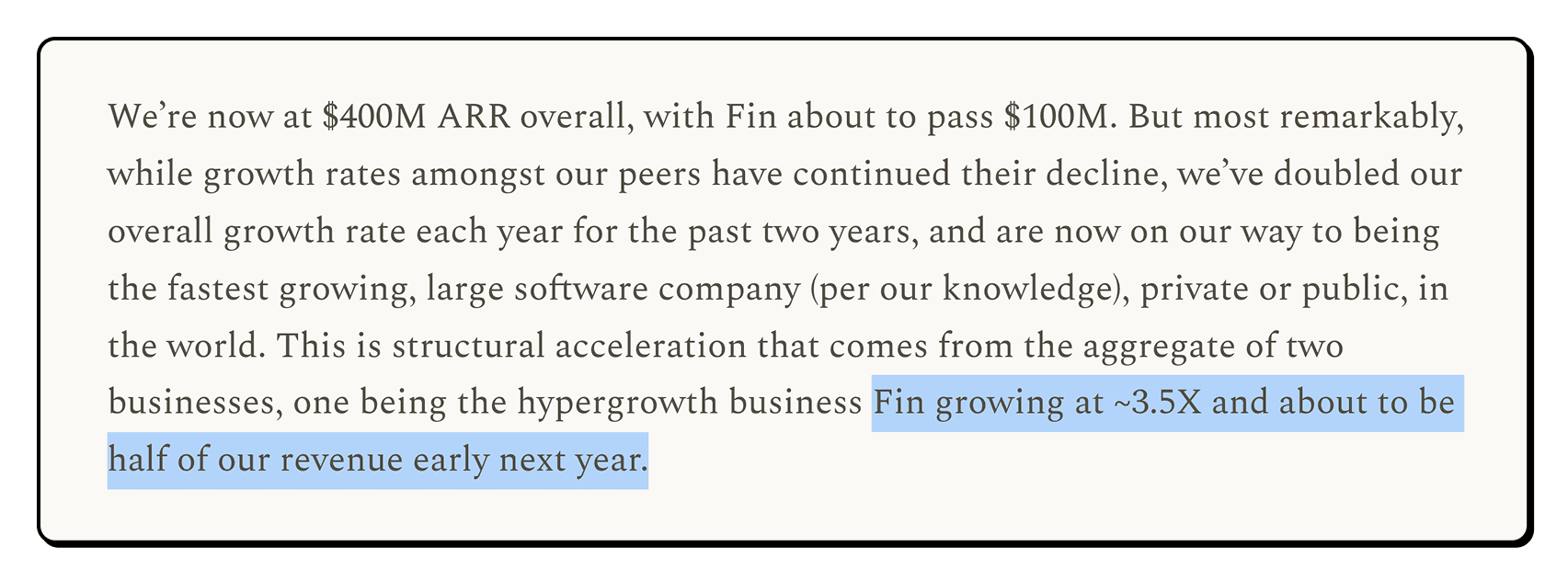
Two examples are Intercom (the legacy platform) and Fin (their AI agent product).
Their founder shared that out of roughly $400 million in ARR, Fin was on track to pass $100 million. It was growing at 3.5 times the speed of their SaaS platform, and was expected to represent about half the company's revenue by the following year.
This helps explain why they made Fin the focus of their positioning.
Ways to mess this up
1) Create an AI category that isn't tied to a job-to-be-done
There are already AI categories that people recognize: AI agents, AI chatbots, AI search. They have dedicated vendors, and they’re becoming more mature.
Some companies resist this.
They’ll say, “I don't want to put myself in one of those existing buckets. That category might be new to us, but I want to be brand new to everyone. We want to be the only company in the category.”
If that’s your aim, your new category needs to connect to a job-to-be-done.
A job-to-be-done is a specific task, workflow, or responsibility owned by someone in an organization. This could go all the way up to the CEO leading a massive company-wide initiative or all the way down to an individual contributor filing an expense report.
It's something that would show up on a job description or a calendar.
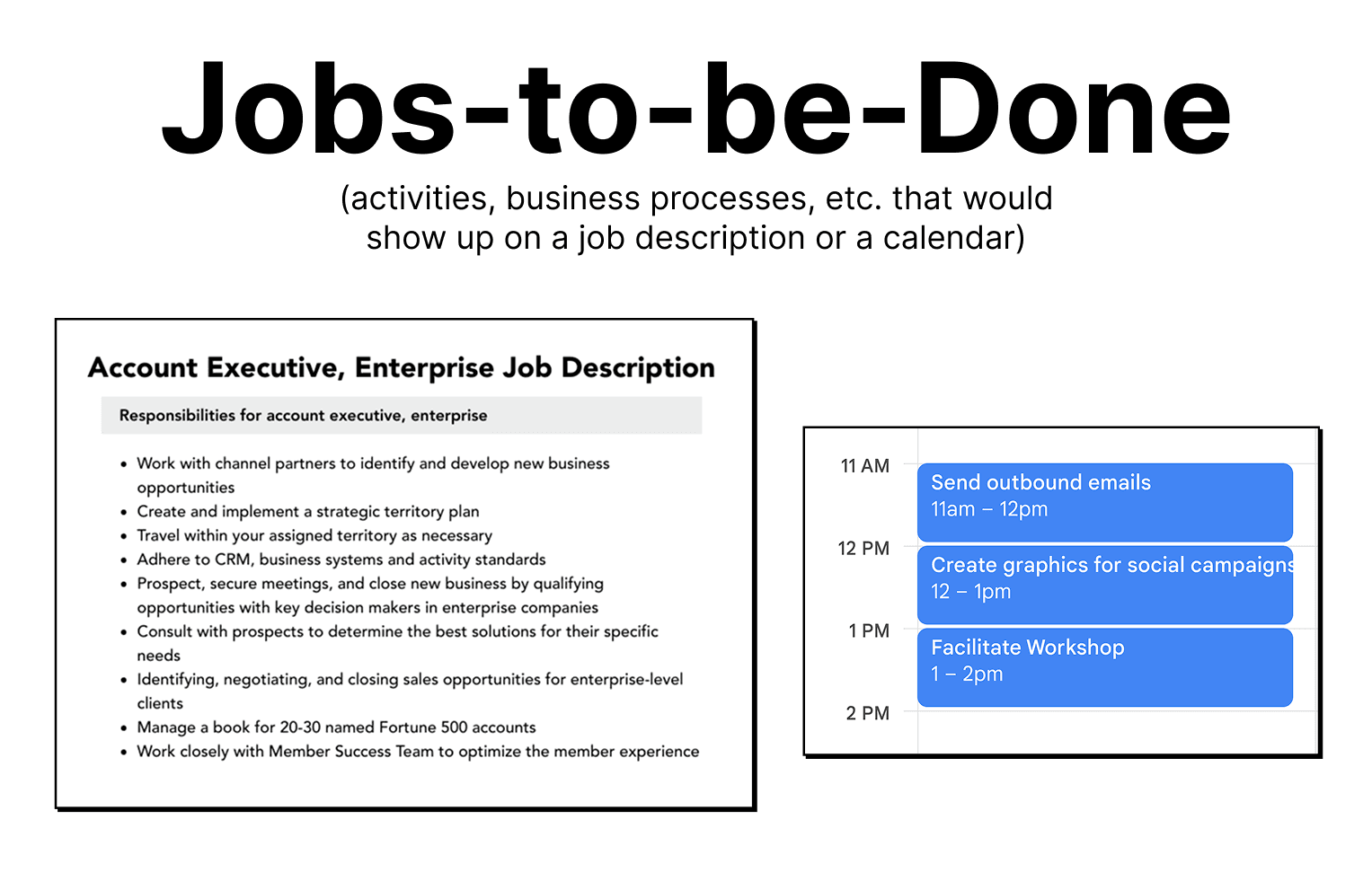
Almost every software category has a corresponding job-to-be-done. Customer relationship management is for managing customer relationships. Project management software is for managing projects.
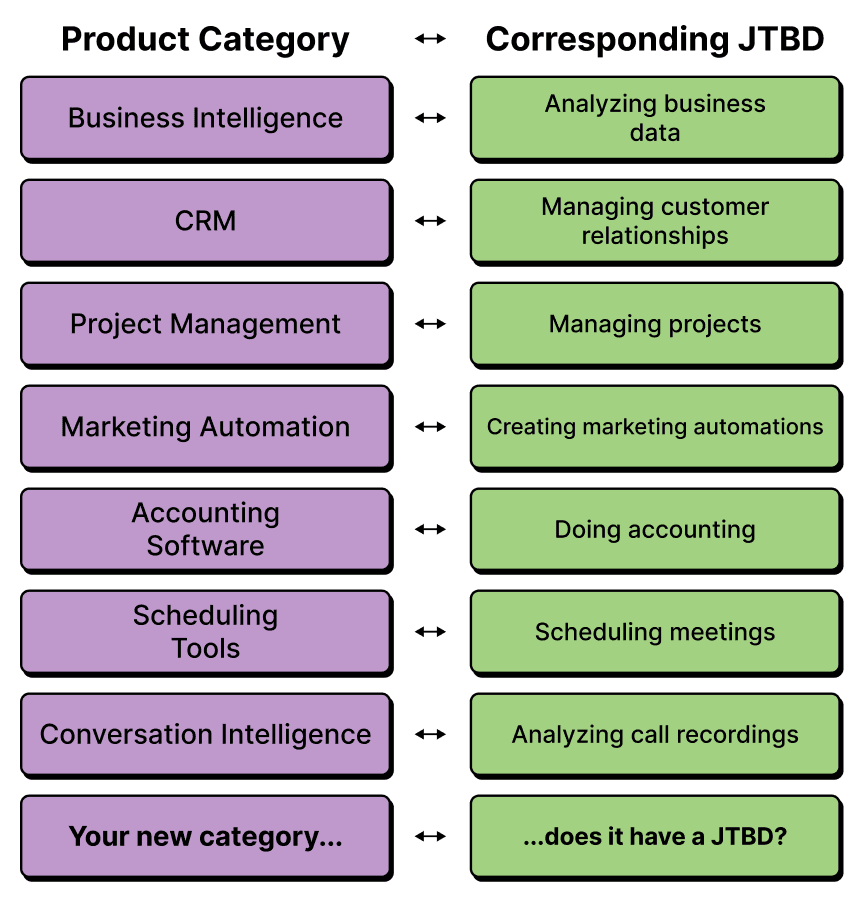
If your new category doesn't connect to anyone's responsibilities, no one will see themselves in it.
You'll always be pushing a boulder uphill, saying, “You should use this.”
And they'll keep replying, “That's not really part of my job.”
So when I see Asana calling themselves “the operating system for human-agent teams,” I try to reverse-engineer the job-to-be-done.
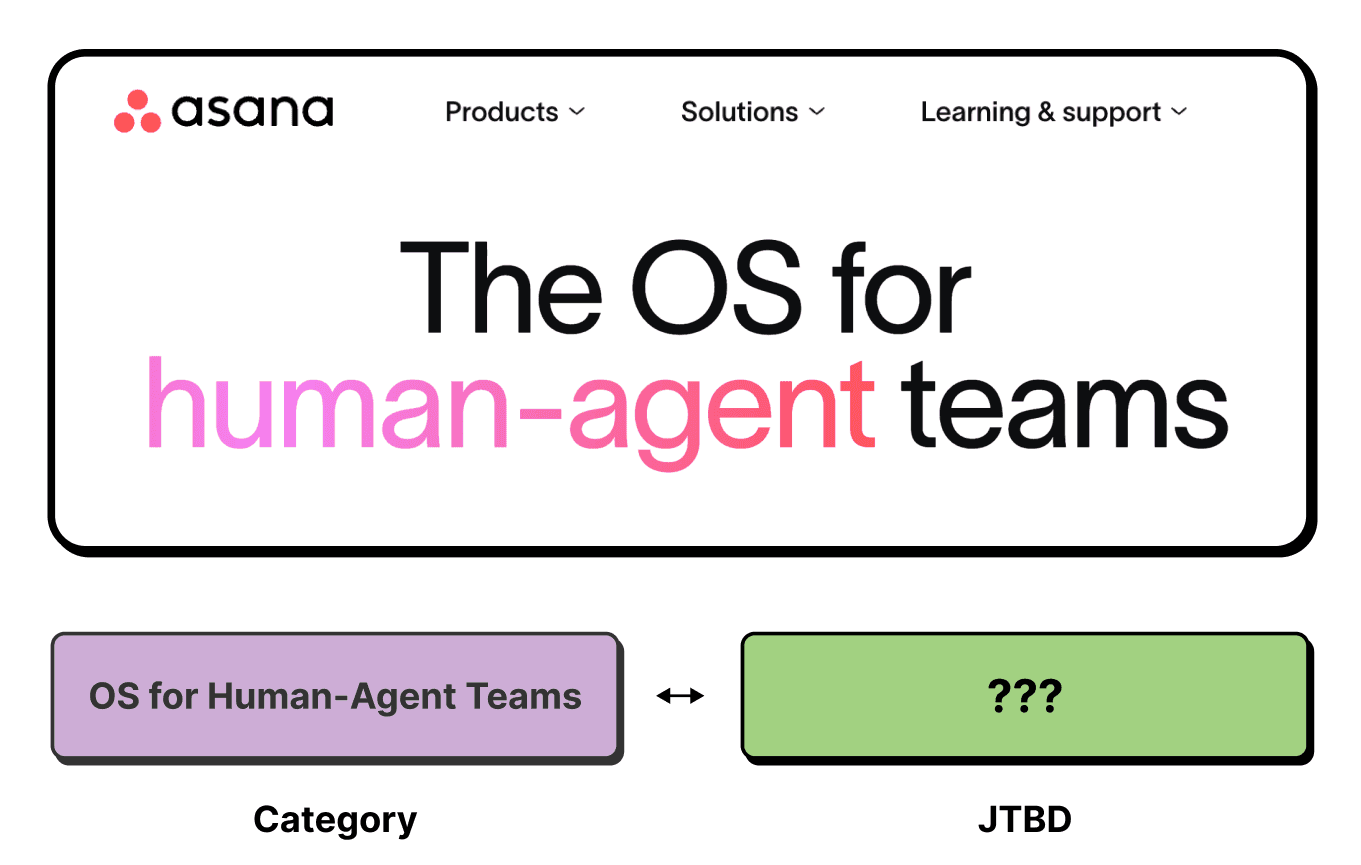
Who owns that?
Whose job description says, “Coordinate collaboration between humans and agents”?
I’m not sure anyone will see this as their role. And I would predict this positioning will not last for Asana in particular because of it.
2) Pivot to a category your customers don't want
I was an Airtable customer for a long time. When they launched their new AI features, the normal functionality of the product became slow and bogged down.
From my perspective, they were stuffing new things into the product while making the original experience worse.
Then Bending Spoons bought Airtable for far less than its previous valuation. One article called Bending Spoons the “Italian Grim Reaper.”
Airtable lost sight of what made it special. They kept chasing different ideas without finding a clear place to land.
You can move into a new category.
But that doesn't mean your customers want to come with you.
Strategy 2: Use AI to differentiate within your existing category
With this strategy, you keep your category and position yourself as the AI version of it.
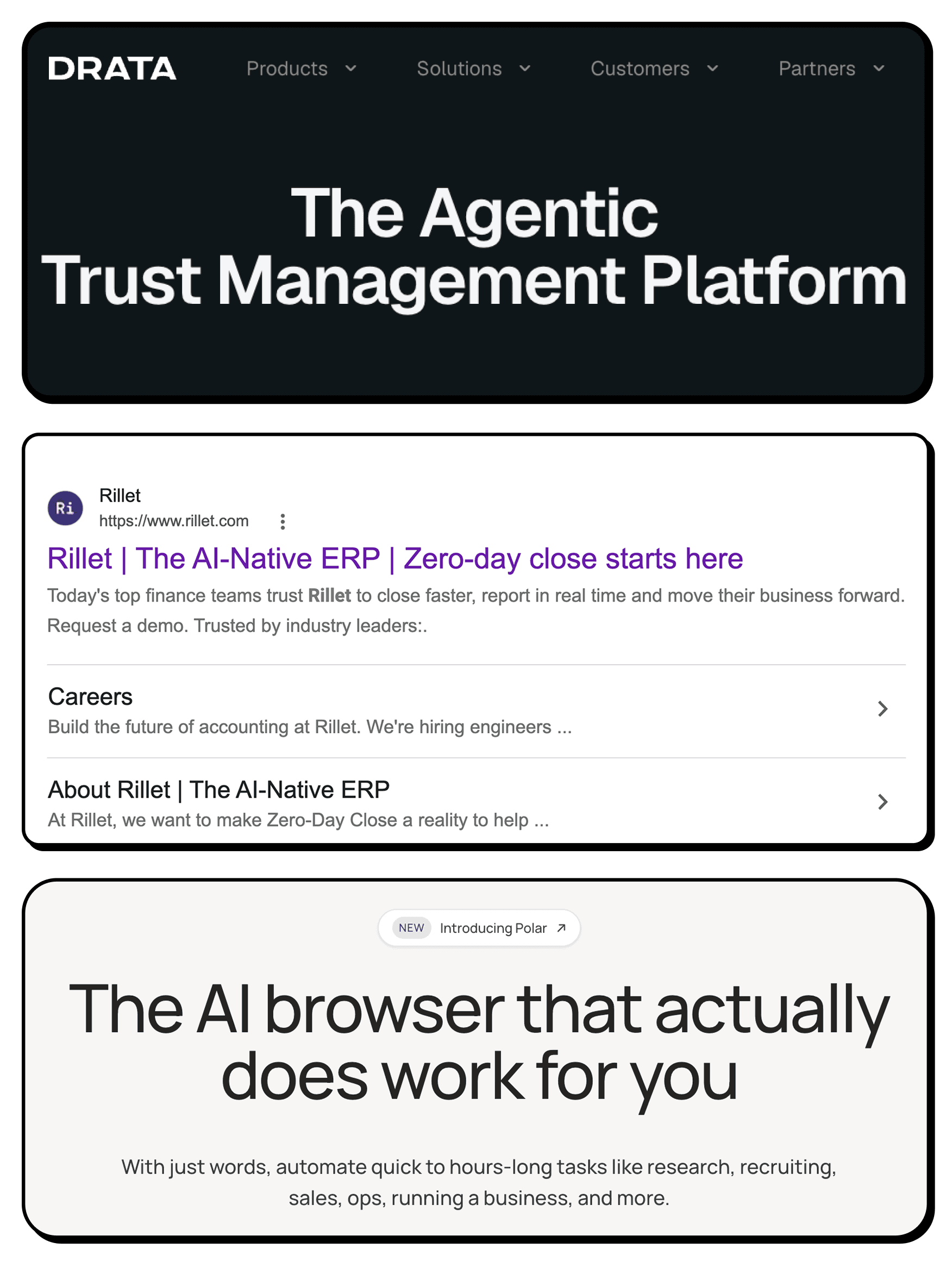
Drata calls itself an “agentic trust management platform.”
Trust management is a real category of software. You can look it up on G2 and see the vendors that play in it. There are specific capabilities and functionality that buyers expect when they shop for a trust management platform.
Drata claims, “We're in the category you already know, but we've agent-ified it.”
You can see the same approach with Rillet, the “AI-native ERP.” ERP is an established category, and Rillet is positioning itself as the AI alternative to the big legacy vendors.
Or consider web browsers. Comet is the AI browser from Perplexity. Dia is the AI browser from Atlassian.
They're both taking an existing category and AI-ifying it to stand out from the “old-school” non-AI players.
Reasons to choose this strategy
1) The legacy players are ripe for disruption
This playbook can work when incumbents are slow to adopt AI, and there’s a big existing market.
Gamma is a great example.
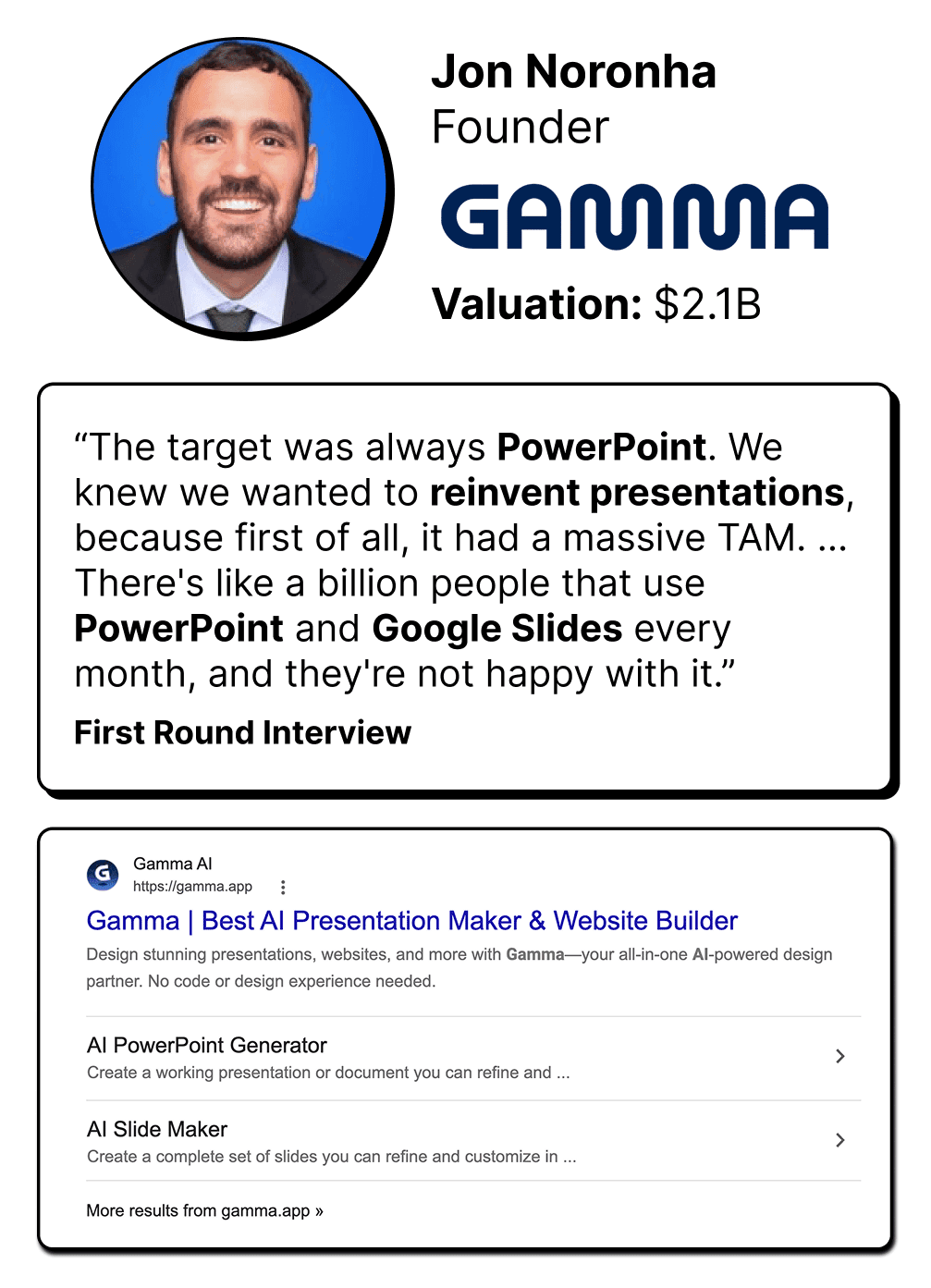
It's effectively an AI-presentation tool, and its co-founder claims that their target was always PowerPoint.
Gamma wanted to reinvent presentations because the market was massive. Around a billion people use PowerPoint and Google Slides every month, and a lot of them aren't happy with the experience.
Gamma saw an opportunity to disrupt these mega players with an AI-powered version of something people already understood and used.
They now do over $100 million in ARR and have a $2 billion valuation.
2) You're willing to look similar to your newer competitors
This is important, but nuanced.
Take the new crop of AI CRMs: Attio, Lightfield, and Day AI. At various points, they've all used some version of “AI-native CRM.”
On the surface, they look very similar to each other.
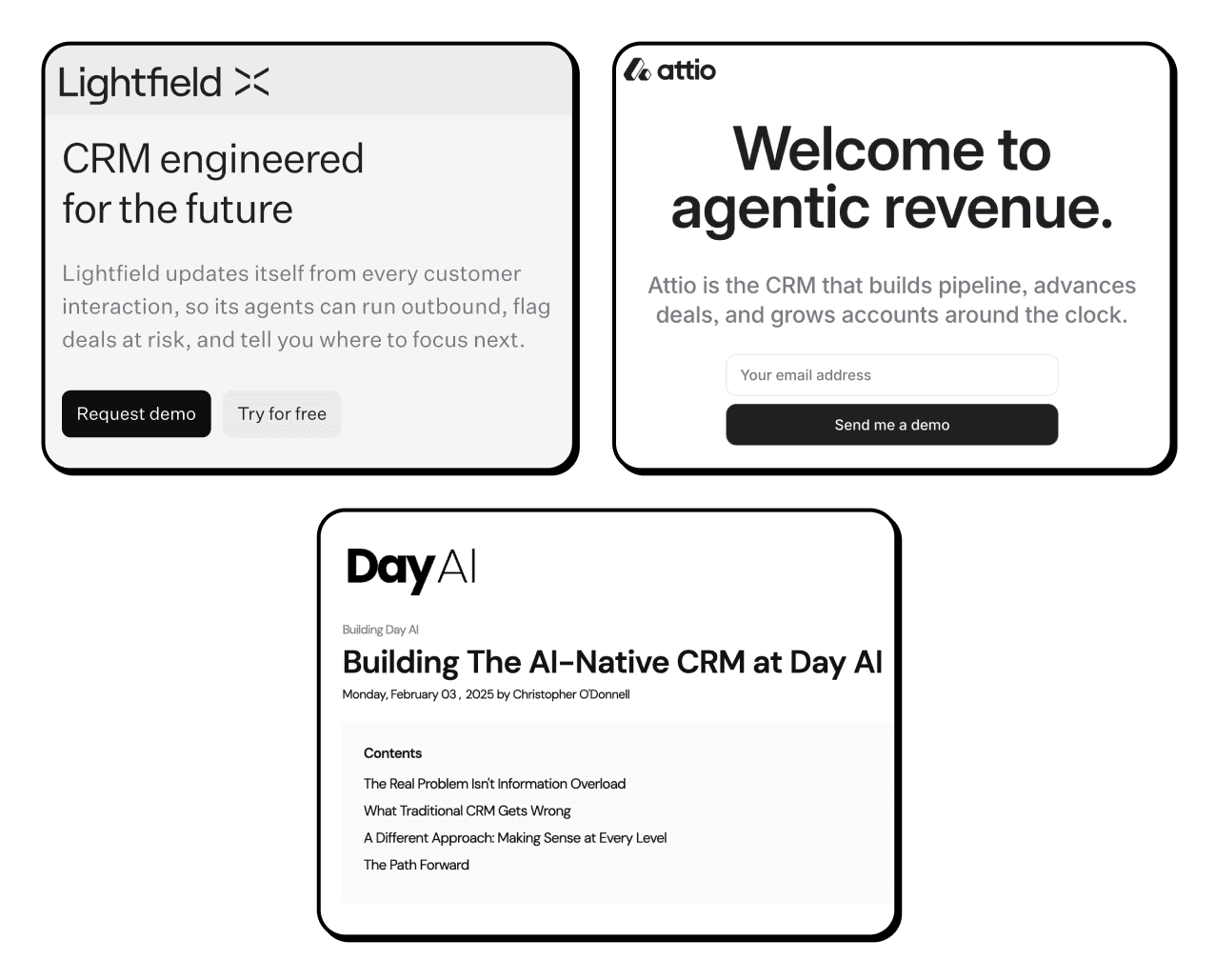
While it might seem like their most important competitors are each other, in reality the biggest enemies are HubSpot and Salesforce.
Most people aren't sitting around asking, “Should I use Lightfield or Day AI?” They're saying, “We'll get HubSpot or Salesforce.” Or even more likely, they're already on one of these industry standard options.
In essence, these companies have two battles to win.
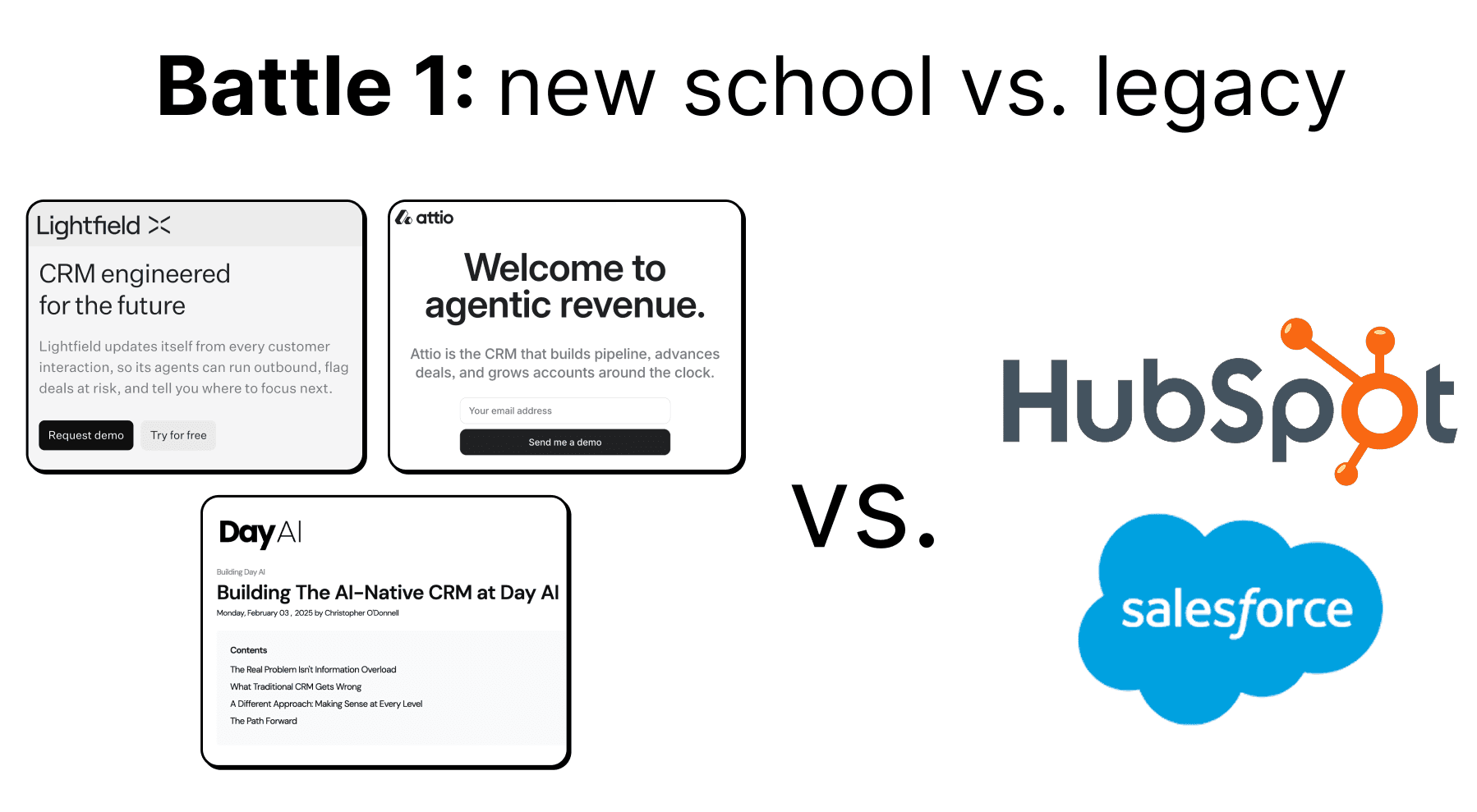
First, they have to convince someone to choose an AI CRM instead of one of the established options.
If they are able to do that, then they have to explain why they're better than the other AI CRMs.
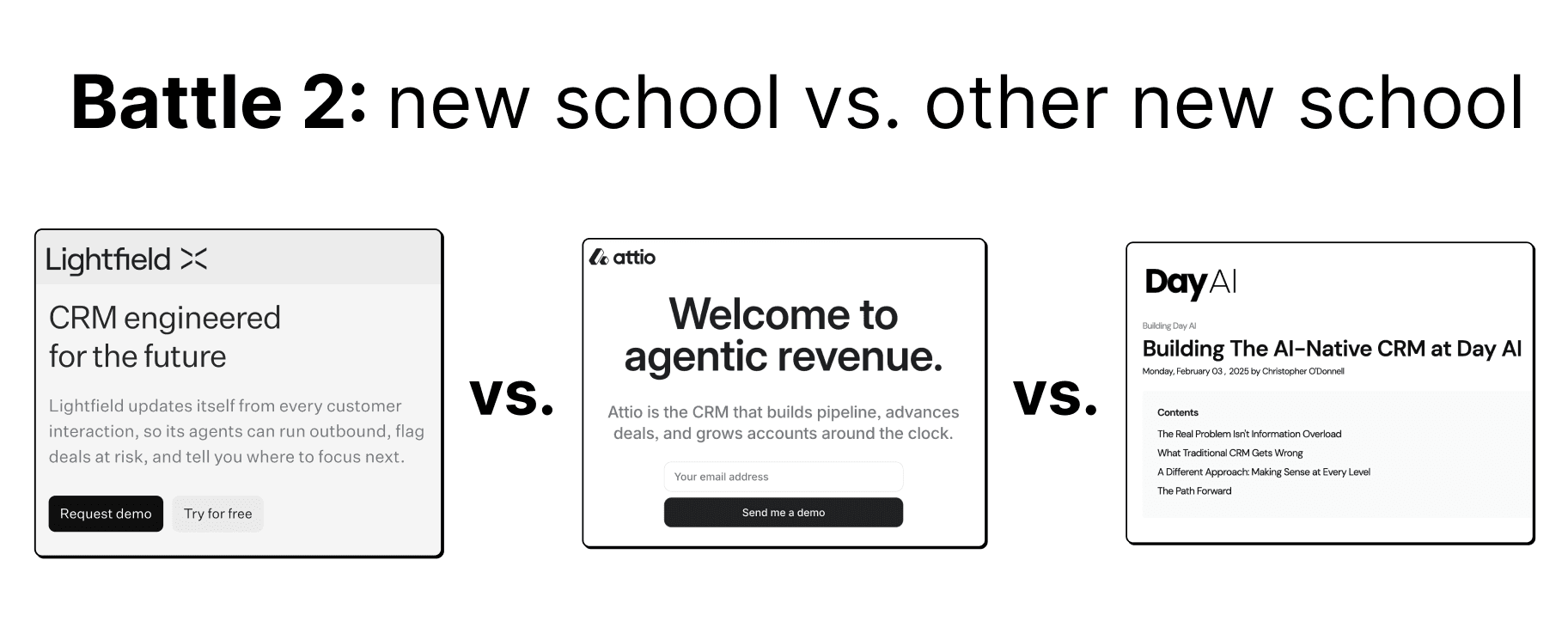
The first battle is the harder one to win. Customers are risk averse, and they default to choosing the tried and true options.
Getting them to take a bet on a startup is an extremely large hurdle.
If you can win that battle, then you can battle with the other newer options. You're taking people out of the market for the legacy product and into the market for the new AI version, then explaining why your version is different.
The differences between them become much more relevant later in the sales process. They don't necessarily need to be the focus of the homepage.
Think about the early search engines. Google, Yahoo, and AltaVista were all trying to get people to use search. It wasn’t necessary for Google's positioning to focus primarily on why it was different from another small search engine.
Or consider Bolt and Lovable. They're effectively saying the same thing, but it’s a land grab, and they are racing to see who can use this message to get more of the overall market first.
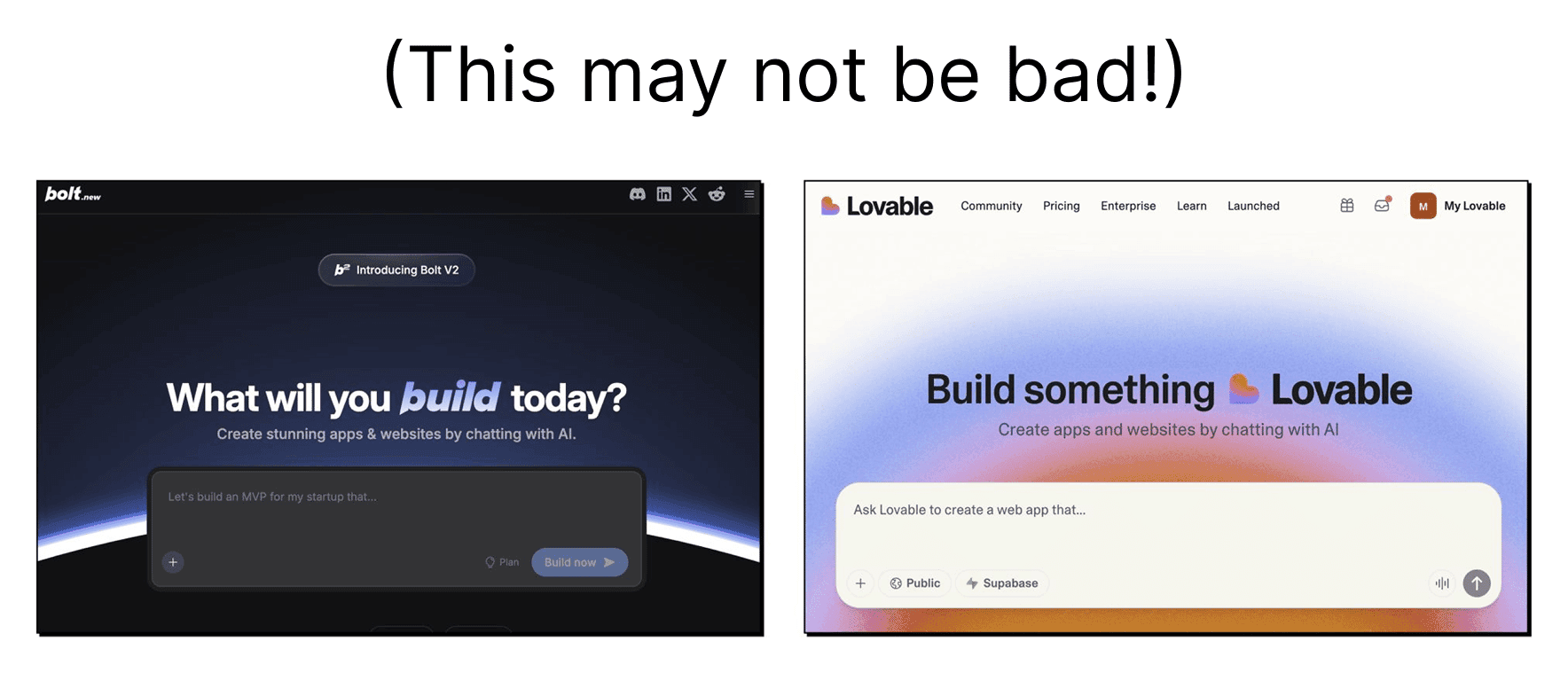
If one of them changed their message just to look different from the other, it could become less relevant to people who haven’t even adopted this type of tool yet.
Sometimes, the same message as your direct competitors is the right message.
In that case, you're going to have to beat them on the battlefield of distribution, rather than on the battlefield of differentiation.
Ways to mess this up
Your AI doesn't work well or your reputation makes the pitch hard to believe
If your AI sucks, people will make fun of your AI-centric positioning.
Take RingCentral, a company known for phone systems. Their positioning became “the agentic voice AI platform to drive customer outcomes.”
On Reddit, the reactions were mostly negative.
People described the call summaries as okay at best, compared them unfavorably to ChatGPT, and called their AI features “lipstick on a pig.” Some even thought the advertising was misleading.
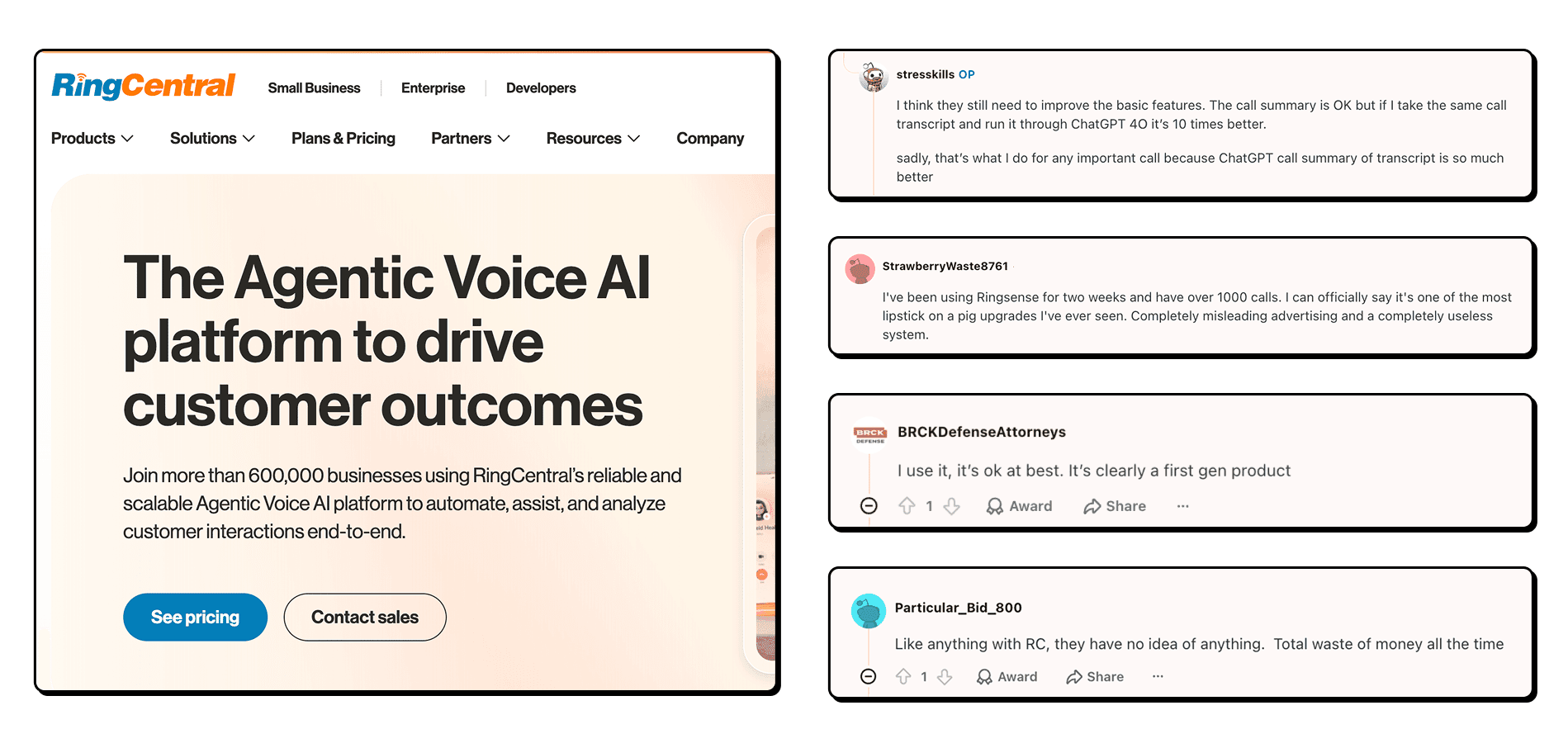
People think of RingCentral as a legacy phone system company. They don’t have a reputation as a company living at the forefront of AI, so their message has a lot to overcome.
You could point to their stock price and argue that the strategy was working for investors. Sometimes a change can help the stock even when customers hate it.
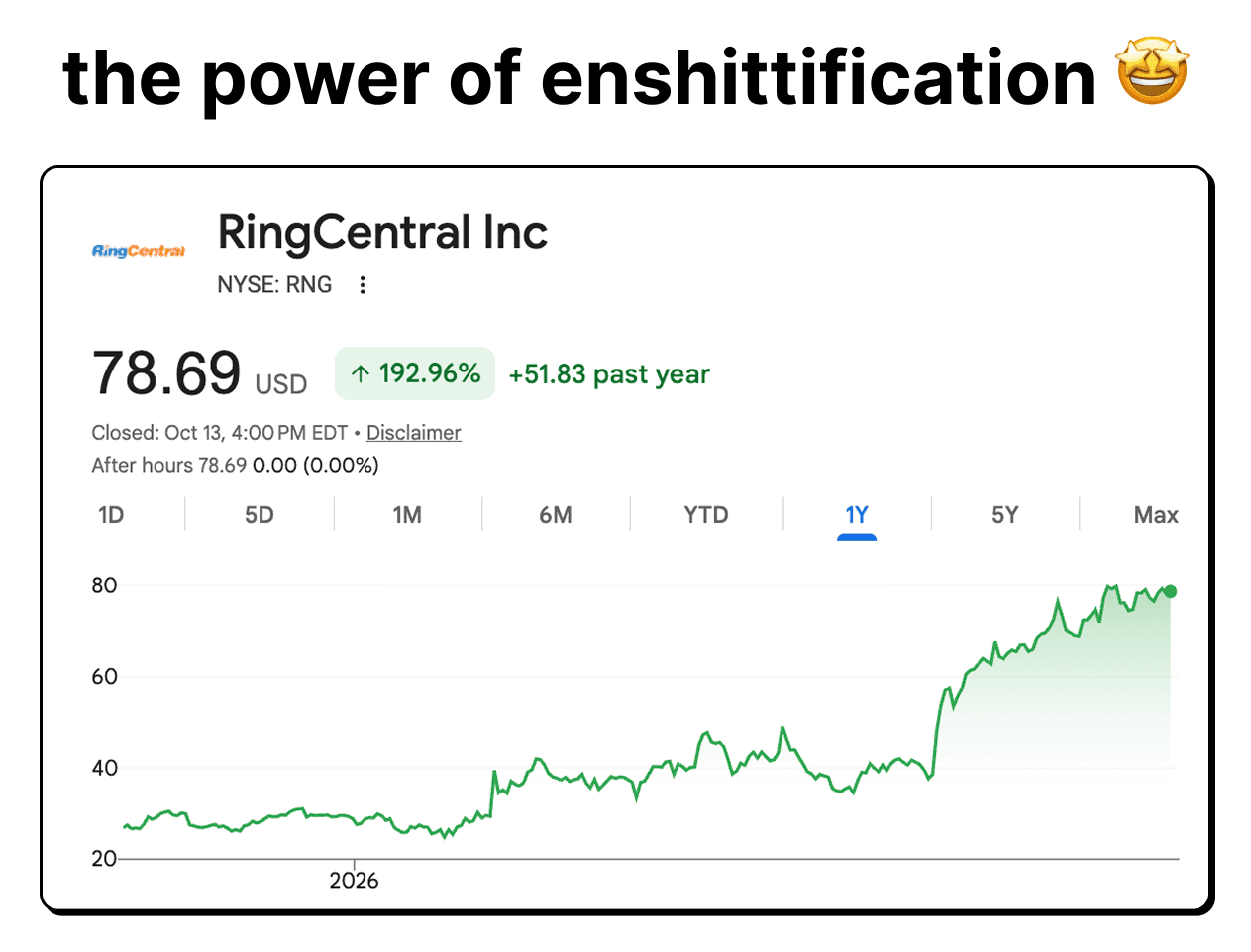
I'll let you decide what to do with that.
But whether or not people believe the pitch does depends largely on your reputation.
Imagine I showed you this headline without a logo:
You might think, “Who is this undifferentiated company? That's what everyone says.”
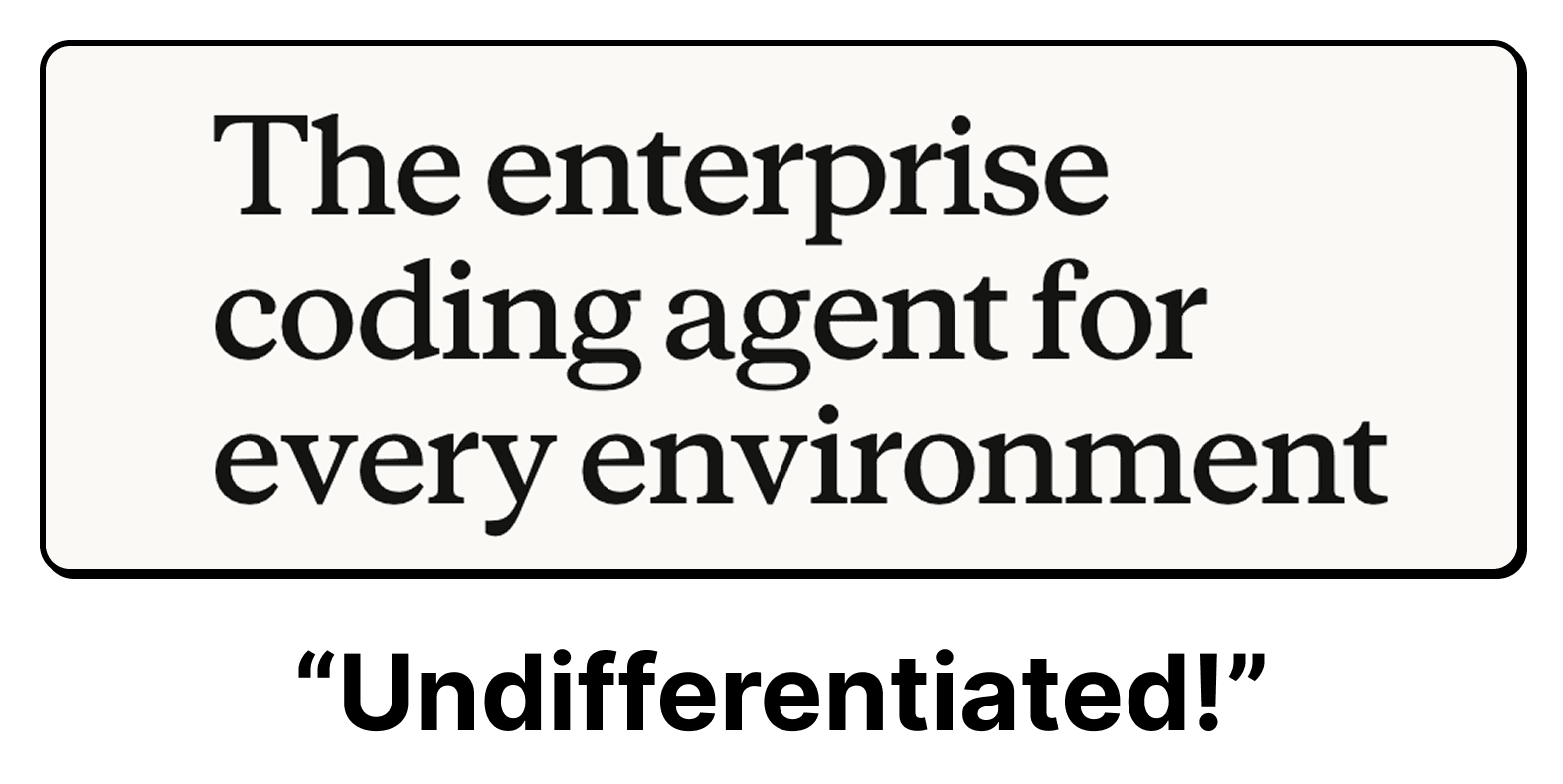
Then I show you that it's Anthropic saying this.
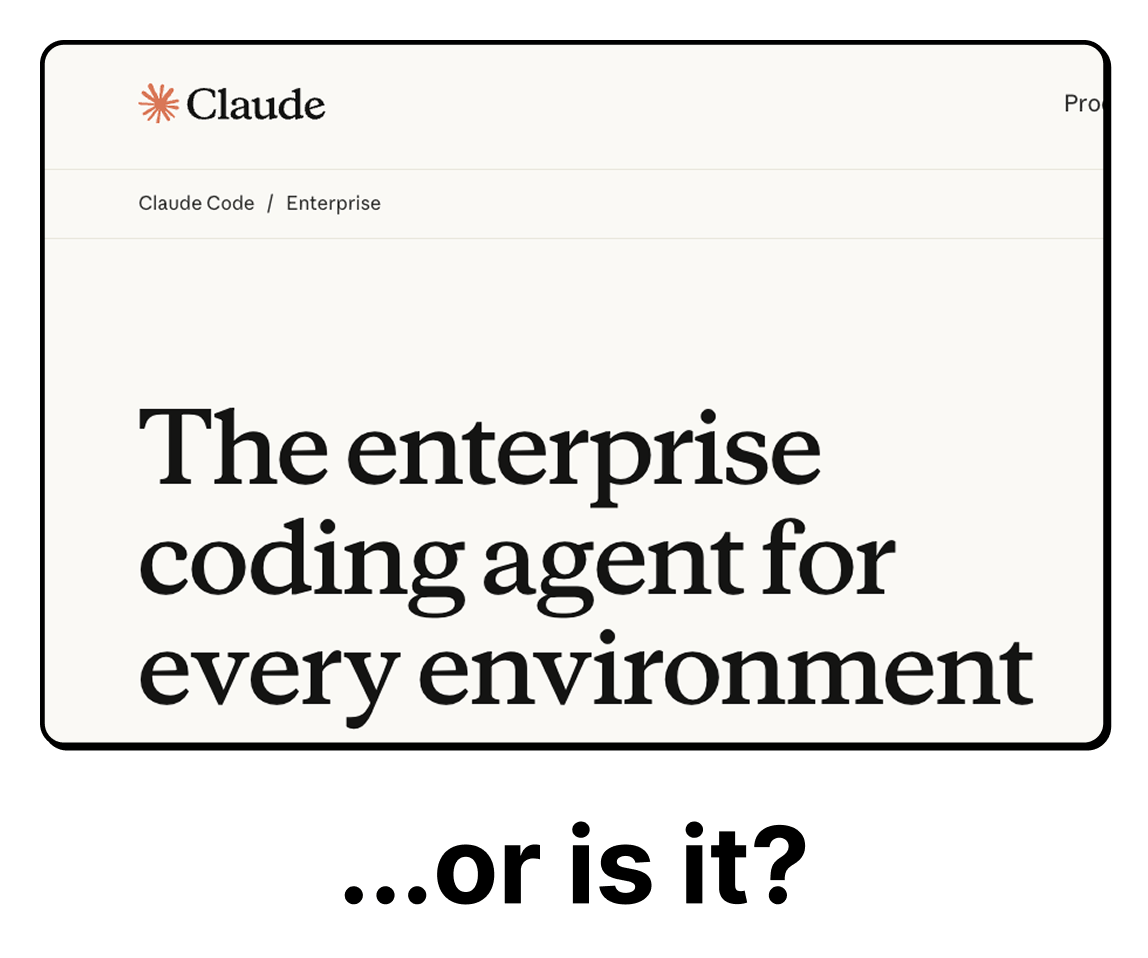
Suddenly, the message feels different.
People know Anthropic for building AI products. Nobody is accusing them of trend-chasing or slapping AI on everything because they’re afraid of falling behind.
It’s not cliche to call yourself AI-native if you actually are.
If you have that reputation, an AI message can work. If you don't, the same words can come across as trend chasing.
Strategy 3: Don't make AI part of your primary positioning
This sounds crazy to some people, but not everyone is putting AI at the center of their message.
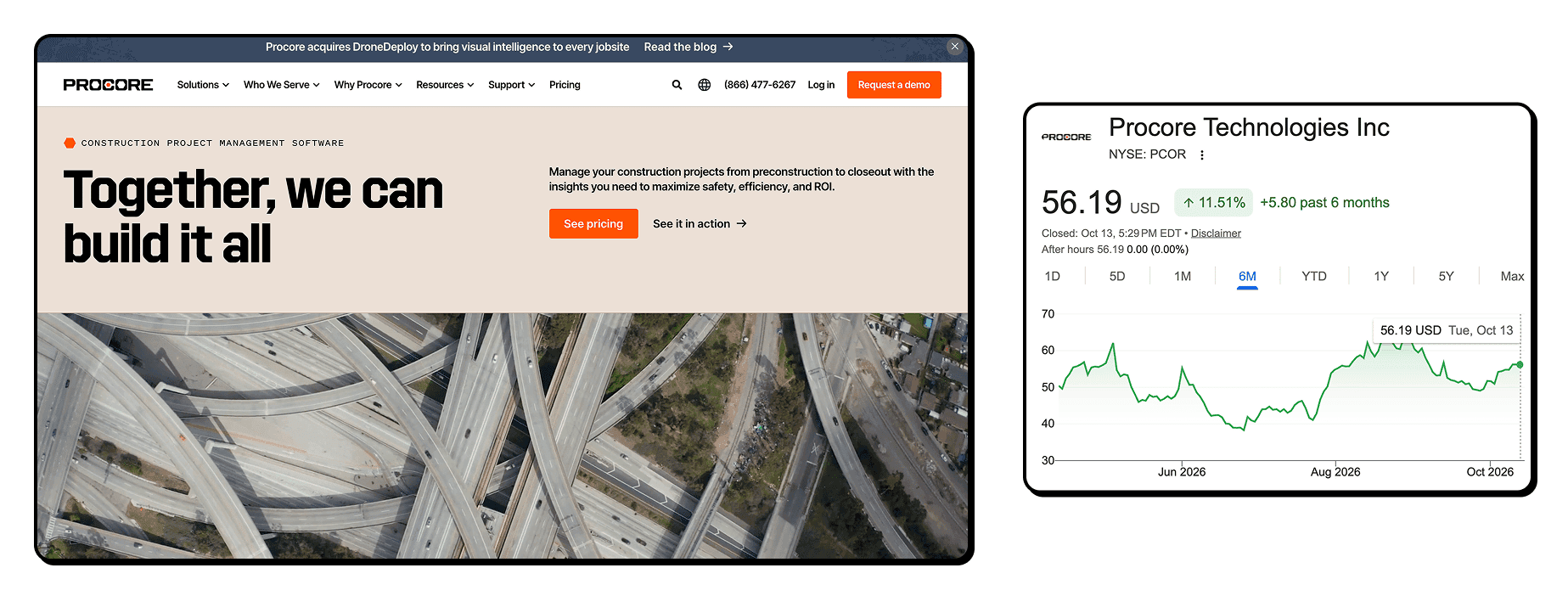
Take Procore.
Its homepage calls itself construction project management software, and reads: “Together we can build it all.” It talks about managing projects from pre-construction to closeout, with the insights needed to improve safety, efficiency, and ROI.
There isn’t a single mention of AI.
Procore’s stock was up 11% over the previous six months. Leaving AI out of the hero isn’t obviously hurting them.
You don't have to jump on the bandwagon.
Some companies are even moving back to their previous SaaS-categories.
For a while, HockeyStack moved away from attribution software and started calling itself “revenue agents for the enterprise.”
Then it went back to “modern attribution.”
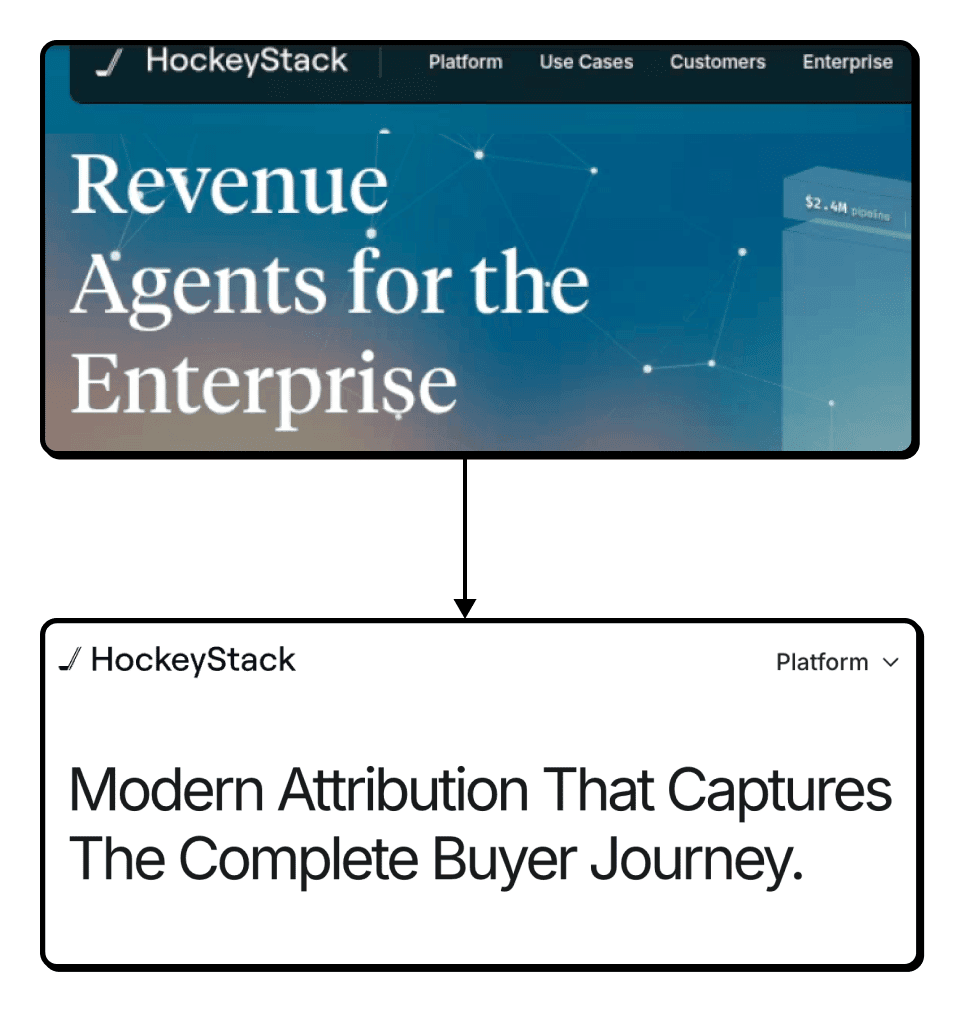
You can imagine why that might happen. Someone who knew HockeyStack for attribution could visit the site and think, “Wait, they don’t do attribution anymore?”
My guess is that the change hurt inbound demand. People looking for attribution assumed that HockeyStack no longer did it… and went somewhere else.
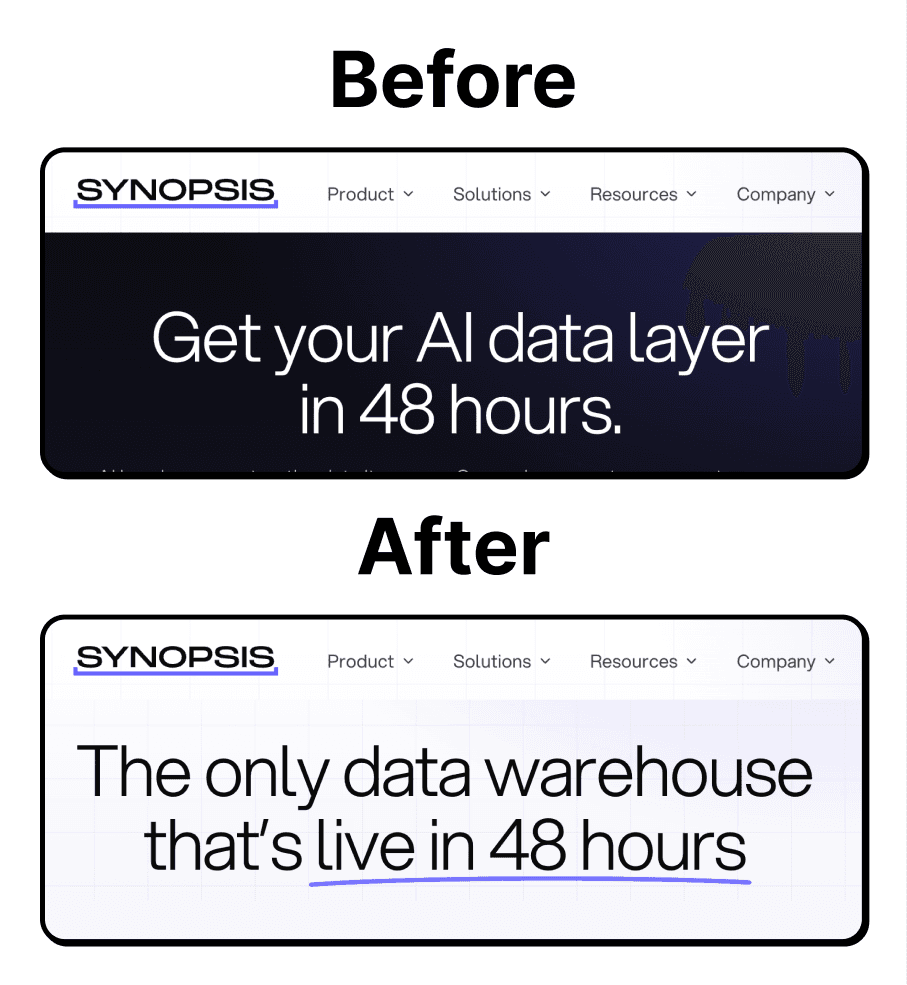
We worked with a company called Synopsis that was selling an “AI data layer.”
During the positioning project, their team realized that most people they were selling to saw them as a data warehouse. In fact, that was what they wanted to buy.
As a result, they repositioned their product in the data warehouse category, and immediately saw better results.
Reasons to choose this strategy
Your customers still want your software category
Some people say SaaS is dead. Other people say, “I still like using software that's tailor-made for the thing I'm trying to do.”
There are things they don't want to do in a chatbot. They want an interface and a product built around the work they need to accomplish.
So ask yourself:
Do people still shop for our category?
Are we already doing well in it?
Do we want to throw that away?
Maybe you don't.
Ways to mess this up
Honestly, I'm less sure there's an obvious way to mess up this strategy just by leaving AI out of your primary positioning.
You could argue that never mentioning AI anywhere might cause LLMs to assume you don't offer it.
But we're talking about your primary positioning.
You can still mention AI throughout your messaging and explain how you use it. It doesn't have to become the defining thing about your company or the main reason someone should choose you.
We would love your feedback on this newsletter! Please shoot over your thoughts to fletcher@fletchpmm.com.
Additionally, if you have someone who you think would be interested in product positioning, consider inviting them to subscribe (just send them this link).
FletchPMM is a positioning consultancy that has helped 600+ B2B software companies find their positioning strategy, document it in an internal deck, and share it on a rewritten homepage.